
Essay and Interview Pedro Ferreira Editor YuMi Hyun
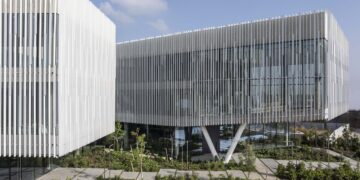
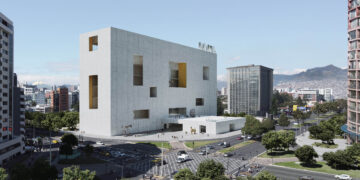
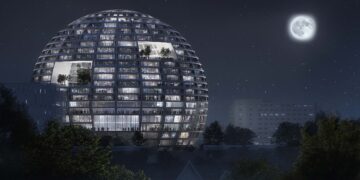
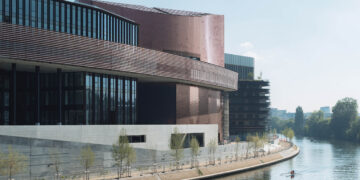
OMA’s work in Asia has often been understood through the force of its images: the hovering box of the Seoul National University Museum of Art, the rotating geometry of Prada Transformer, the mineral mass of Galleria Gwanggyo, or now the crystalline presence of Hangzhou Prism. Yet in conversation with Chris van Duijn, another, more precise reading begins to emerge. The image is never the beginning of the project. It is the residue of a question. What matters first is not the production of a singular object, but the patient construction of a condition in which architecture can absorb, redirect, and intensify the energies already latent in a place.
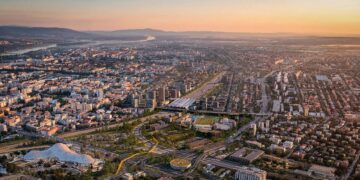
This is perhaps the central lesson of the conversation: for OMA, context is not a decorative obligation, nor a catalogue of local signs to be translated into form. It is a field of contradictions from which the right question must be extracted. In Hangzhou, the contradiction was immediate. Future Tech City carried an enormous ambition: technology, innovation, artificial intelligence, start-up culture, and a new metropolitan future. But the physical reality, at the moment of first encounter, was still generic: roads, empty plots, conventional towers, and a planned district whose buildings did not yet embody the intensity of the idea they were supposed to host. The task, then, was to ask what kind of architecture could make innovation spatially plausible.
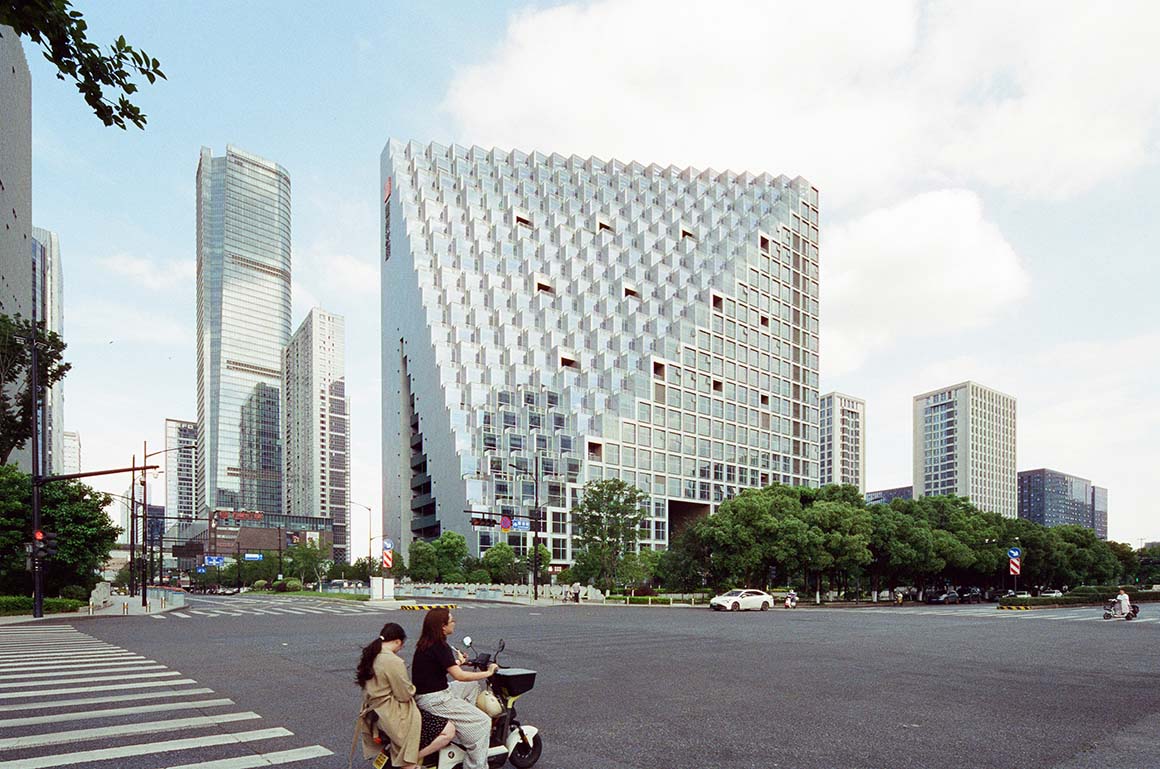
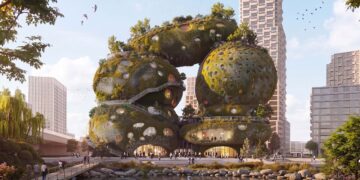
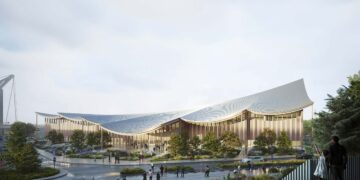
Van Duijn’s answer is striking because it moves away from the mythology of innovation as something produced in meeting rooms, offices, or controlled corporate environments. Instead, he insists on the uncertain social geography of invention: the corridor, the terrace, the plaza, the shared threshold, the accidental meeting, the evening return from work, the informal presence of neighbours, visitors, hotel guests, start-ups, children, and strangers. Hangzhou Prism becomes less a tower than a three-dimensional village, an attempt to insert into a planned technology district the very thing planning often fails to produce: unprogrammed life.
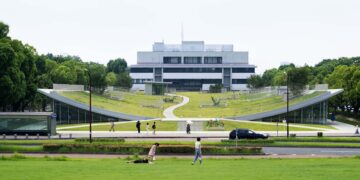
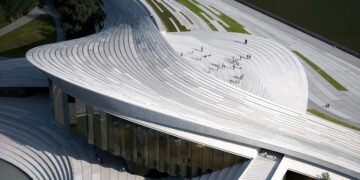
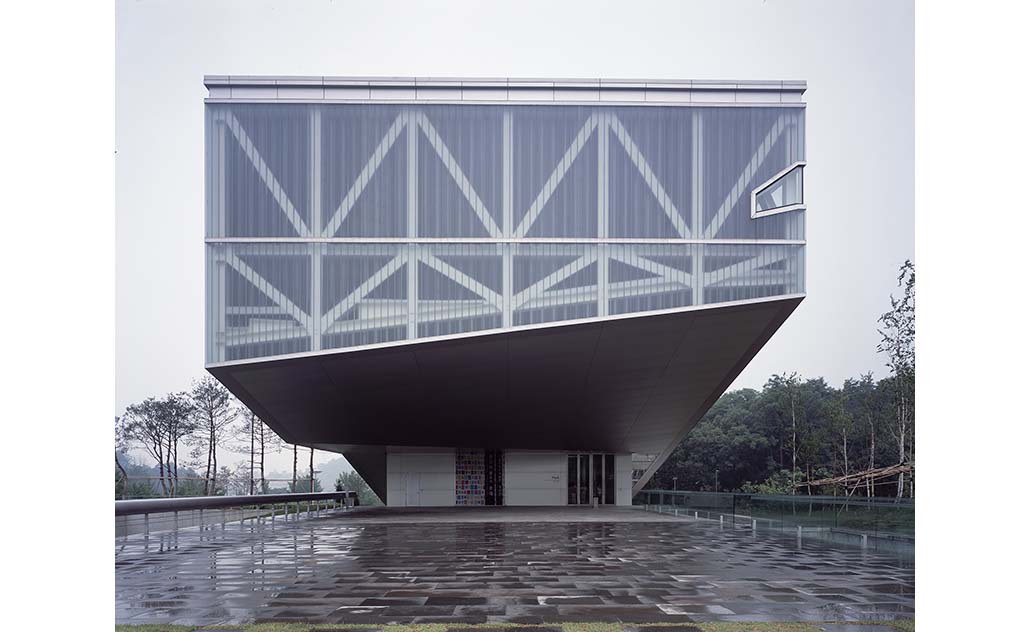
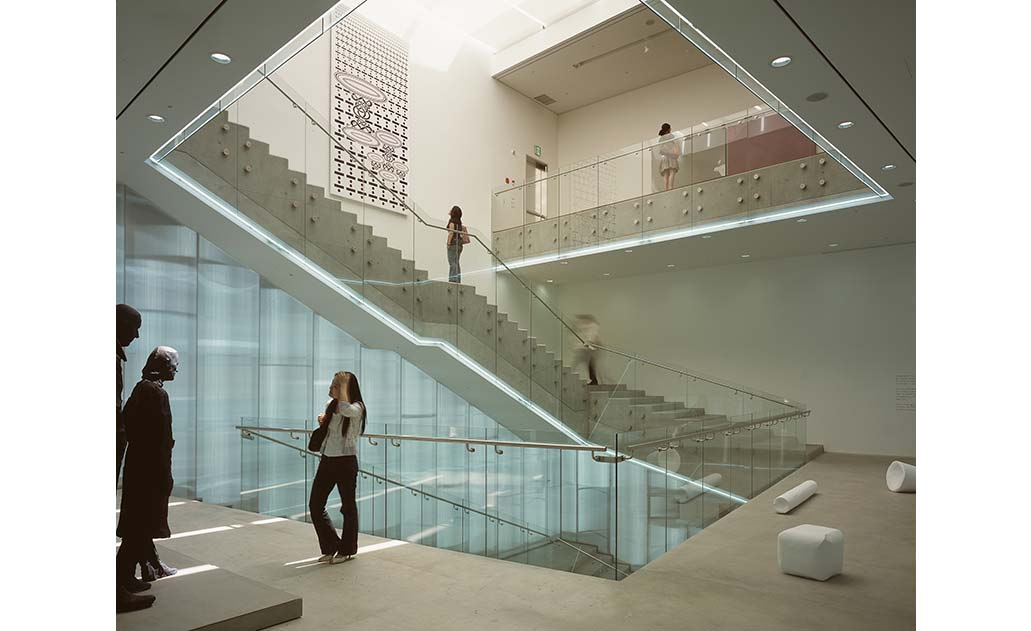
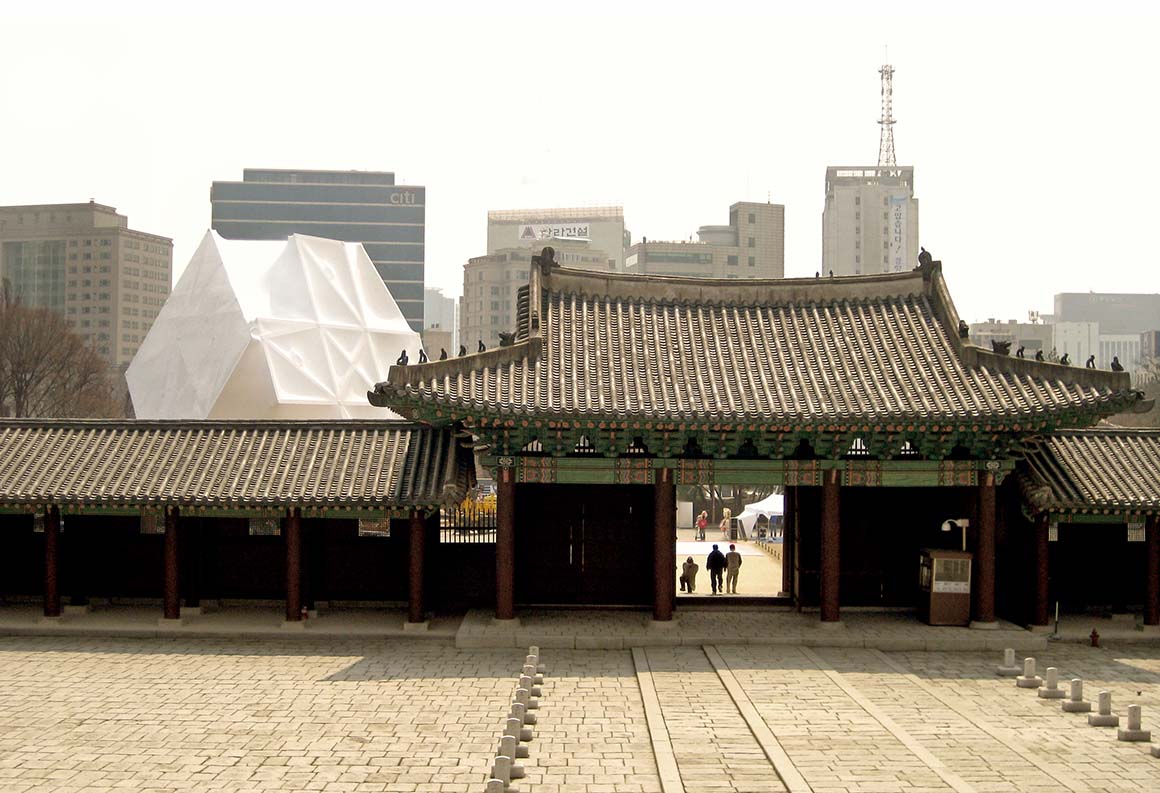
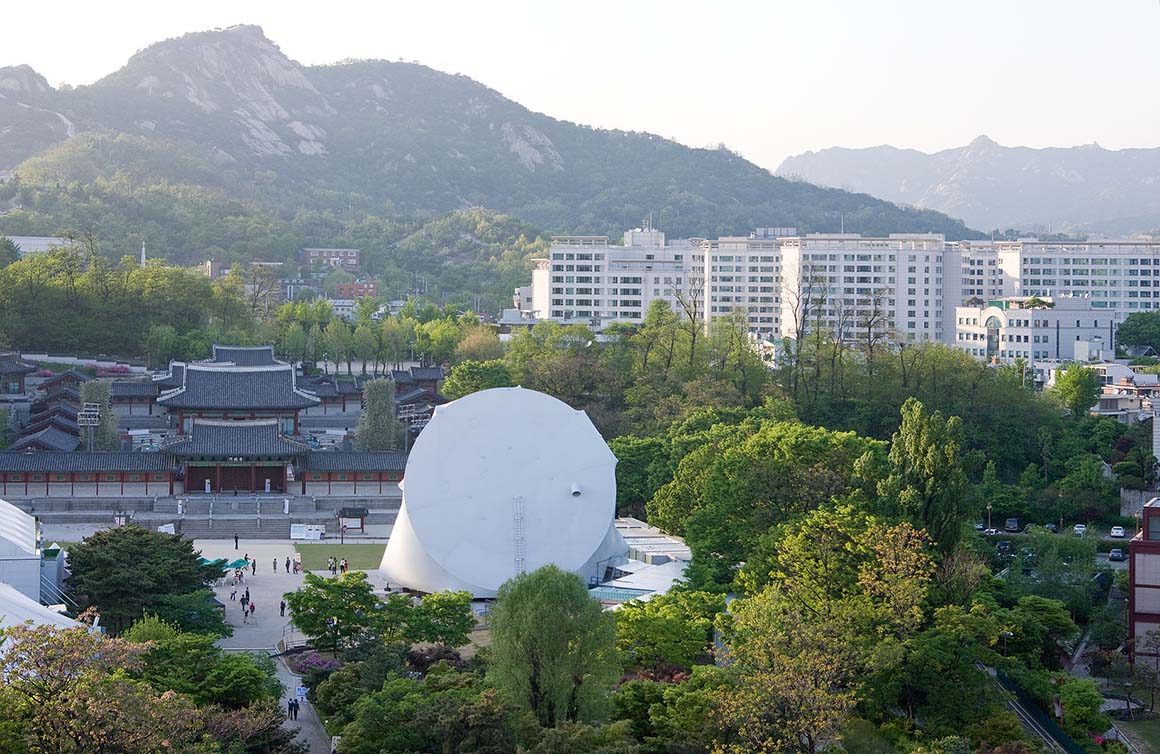
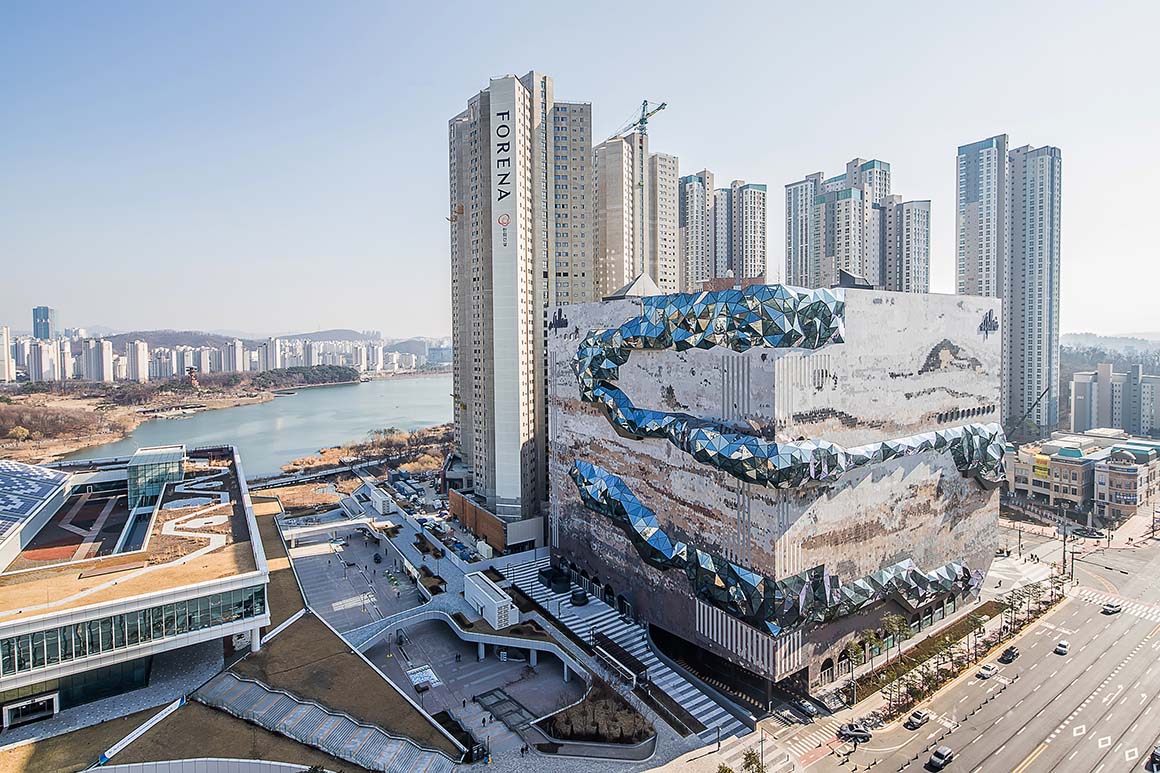
This concern with the in-between also connects Hangzhou to OMA’s longer engagement with Korea. In Seoul, the question has never been only how to build an object in the city, but how to negotiate density, topography, speed, publicness, and latent movement. The Seoul National University had already explored this tension by lifting itself from the ground and allowing the terrain to pass underneath. Prada Transformer, in another register, understood architecture as a temporary apparatus for cultural transformation. Galleria Gwanggyo converted a commercial building into an urban body whose public route unsettles the autonomy of the department store. The Hongik University project now extends this trajectory with unusual clarity: the “landmark” that distances itself from being a new icon assumes a position of negotiating an infrastructural condition.
This distinction is decisive. In the Hongik competition, the brief asked for a landmark and for a spatial manifestation of the university’s identity. A more conventional response might have produced a memorable façade, an emblematic silhouette, or a symbolic interpretation of Korean culture. OMA’s response was different. Van Duijn describes walking through the campus, getting lost, observing students, professors, courtyards, informal occupations, workshops, thresholds, and the unstable relationship between Hongik University and Hongdae. What emerged was an organism: a campus made of levels, shortcuts, appropriations, hidden continuities, and social overflow.
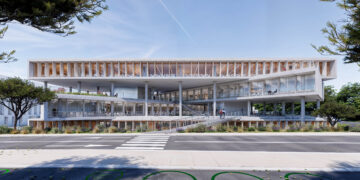
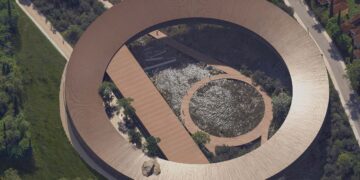
The new campus therefore becomes architecture as connective tissue. It reinstates the slope of Wau Mountain, reconnects the campus to the neighbourhood, introduces a shared Hongdae level, and organizes future flexibility through section rather than through image. The project’s most radical gesture may be precisely what it refuses to occupy: the centre remains open. In a culture of architectural assertion, this is nothing less then a powerful act. The building becomes a structure of availability, a framework for future forms of education, work, making, leisure, and public encounter that cannot yet be fully predicted.
Across the conversation, one senses that OMA’s method is neither anti-contextual nor simply contextual in the conventional sense. It is diagnostic. It looks for the pressure point where a city, institution, client, or district reveals what it lacks. In Hangzhou, what was missing was an urban condenser for a planned innovation culture. At Hongik, what was missing was not identity, but a way of giving spatial continuity to an identity already alive in the informal behaviour of students and the surrounding district. In both cases, architecture prepares the ground on which life can become more visible, more mixed, and more durable.
What this conversation finally offers is a less spectacular but more consequential understanding of OMA’s work. Behind the apparent boldness of form lies a disciplined attention to use, movement, conflict, and time. Buildings are never treated as finished objects. They are provisional frameworks, capable of absorbing futures that cannot be fully known at the moment of completion. This may be the deeper continuity between Seoul and Hangzhou, between university and technology city, between topography and plaza: architecture as infrastructure for the unforeseen.

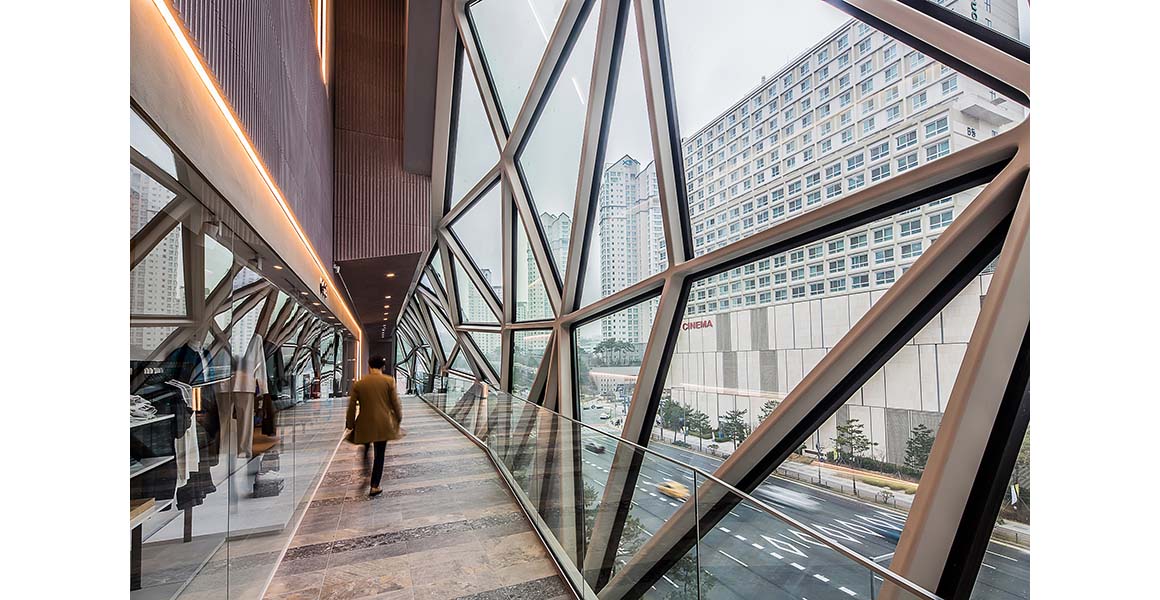
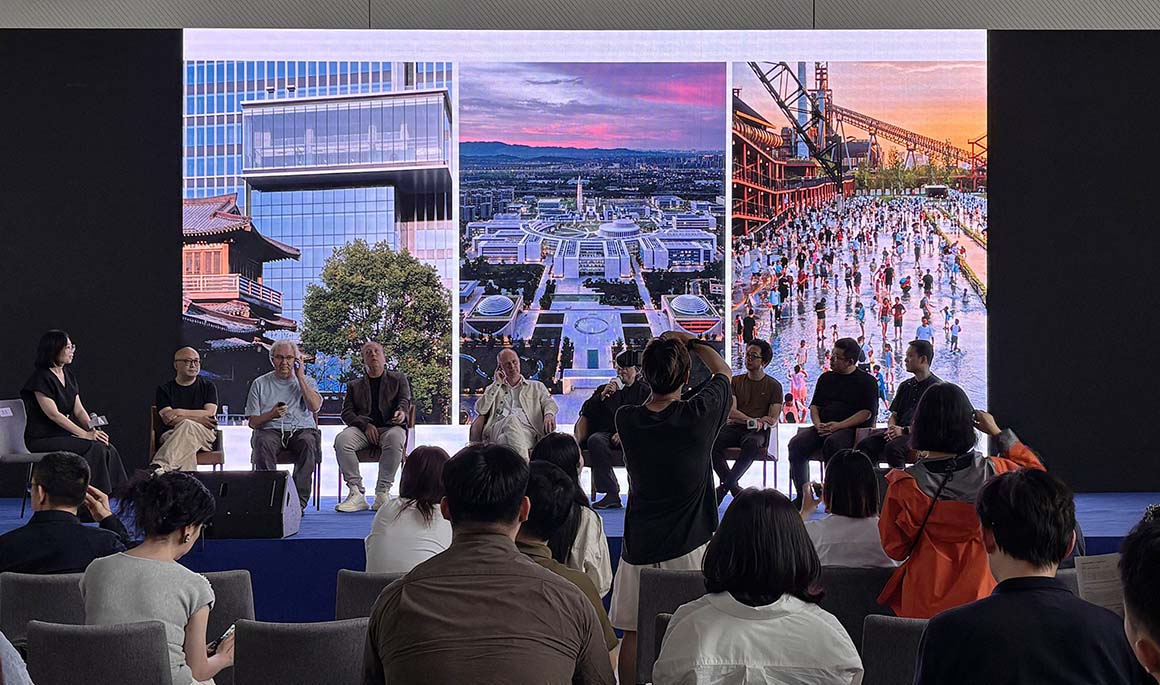
In this interview, Chris van Duijn discusses how OMA begins a project by asking the right question, how context becomes a conceptual tool, and how the Hongik University Seoul Campus proposal emerged from the complex conditions of Seoul, Hongdae, and the existing campus. Moving between Hangzhou Prism, Axel Springer Campus, and Hongik University, the conversation reveals an approach to architecture that goes beyond the making of isolated objects, engaging instead with urban conditions, shared frameworks, and possibilities for future use.
Future Tech City and the Space of Innovation
YuMi Hyun: In your presentation in Hangzhou, you mentioned that when you first visited Future Tech City, there was a gap between the ambitious idea of the district and the rather conventional buildings being planned around it. You also said that innovation does not necessarily happen inside offices or meeting rooms, but often through chance encounters. How did this idea shape the spatial concept of Hangzhou Prism?
Chris van Duijn: One of the fascinating things about China is the strong belief that many things can be planned and made. Things that elsewhere may have developed over decades, or even centuries — or, in the case of Silicon Valley, came into being precisely because there was no planning — are approached in China with a belief that they can be organized, planned, and built.
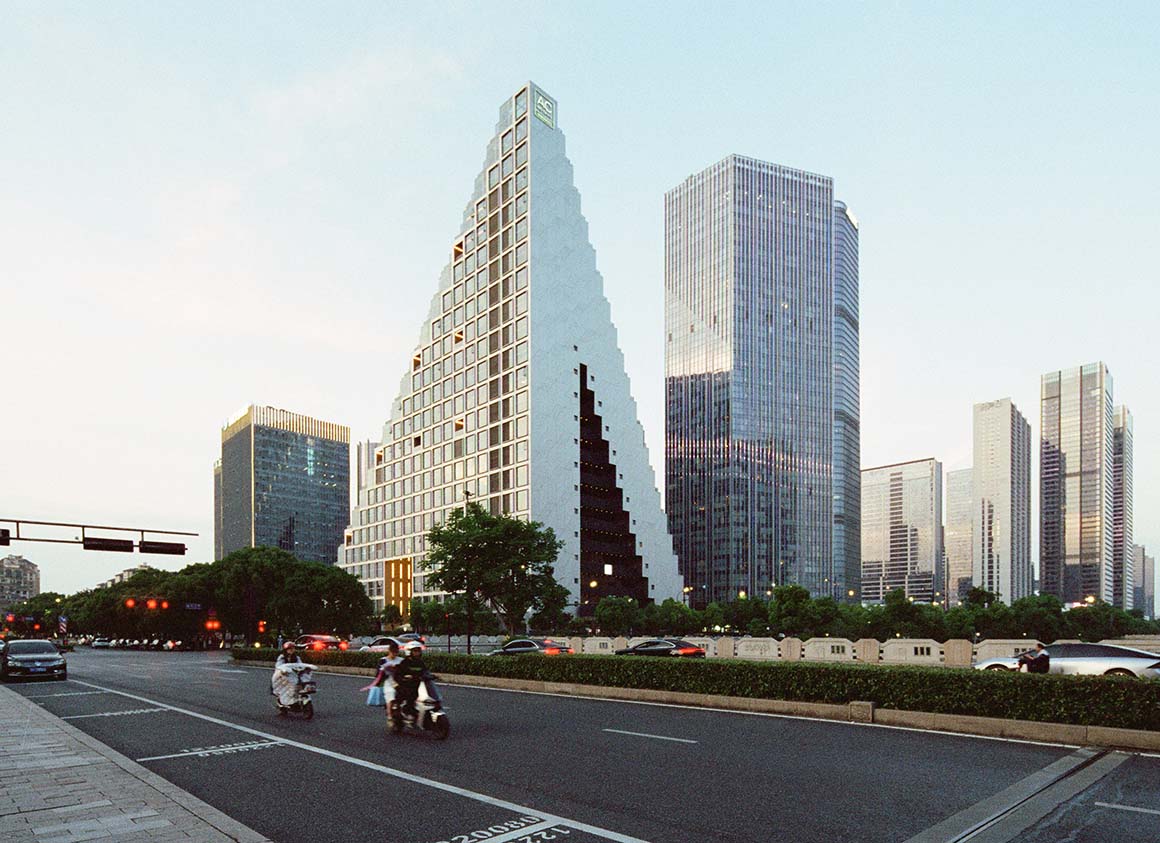
These innovation districts belong to that context. At the time, many such areas were being planned across China, often at a scale far beyond that of a neighborhood. Some are places where 100,000 to 300,000 people live, work, and spend their daily lives. The idea of a city based on technology, AI, and innovation sounds very intriguing. But when we arrived on site, we saw roads already laid out, empty plots, and the first towers beginning to emerge. It could have been almost anywhere in China.
So there was a certain disappointment, because there was a strong contrast between the image we had imagined and what we actually saw. Our site was at the center of the CBD, where one might expect the most intense expression of this technological ambition. Yet the surrounding plans and the site guidelines did not suggest anything fundamentally different from a typical CBD or urban district.
That became interesting for us. We began to ask: what can we contribute to this area? Can we bring in a design that resonates more strongly with this ambition? The ambition itself was serious, and we wanted the building to respond to it.
At first, the main program was residential. But housing alone is somewhat limited in what it can contribute to such an ambition. We began to think about the users. Many people working in these districts are young professionals in their first or second job. They often come alone to live here and spend very long hours at work.
After working all day in the center of Hangzhou, what do they do in the evening? They go back to their apartment, enter a tower, go up to a small unit, and eat the dinner they bought from a local takeaway. If I were working here, I would want to come home to a place where there is an opportunity to engage with friends, neighbors, and other people — a place where one can feel part of life. It does not have to be hectic or surrounded by cars, but it should feel like part of a local community, almost like a village.
Many good ideas are not born behind a desk or in a meeting room. They often emerge in the spaces in between, where people meet by chance and start talking. For us, that became the potential of the building: to create a place where residents, hotel guests, people coming for meetings, start-ups, and others could encounter one another and take over the space.
We wanted to create an energy that you do not find in fenced-off corporate headquarters, or in residential compounds with twenty identical towers, each with one entrance and one elevator. Something is missing in between. That missing element became the starting point of the project. The building later evolved into its particular form, but this was the underlying intention.
From Landscaped Atrium to Open Plaza
YuMi Hyun: In the early images, the central atrium appeared much more landscaped, almost as if Hangzhou’s natural character could pass through the building and connect the park, the canal, and the city. In the completed project, however, it has become a more open, paved plaza — accessible from all directions and flexible in use. How do you see this shift between the original landscape idea and the built reality?
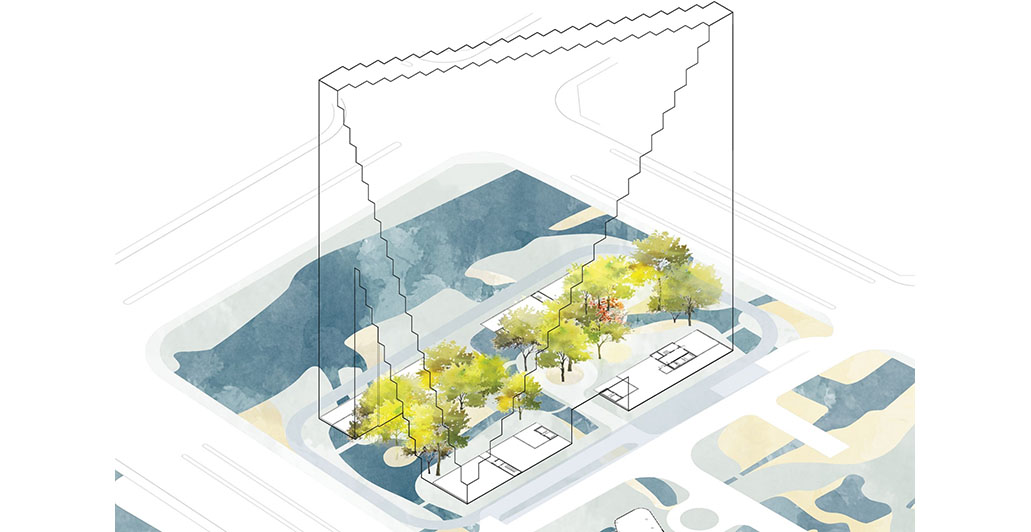
Chris van Duijn: At the beginning, we had a very romantic idea. The Xixi Wetlands are nearby, with beautiful curving waterways and greenery. We wanted to bring some of that natural landscape into the project.
But there were many practical reasons why that became difficult. Bringing in a lot of greenery requires daylight and maintenance, and there were also concerns from the fire department. At one point, we thought of the space almost as a mobile park. We could still have larger trees, but they would need to be movable. You could rotate them, or move them outside for a while and bring them back in again. In that way, objects could be moved around and the space could accommodate different events.
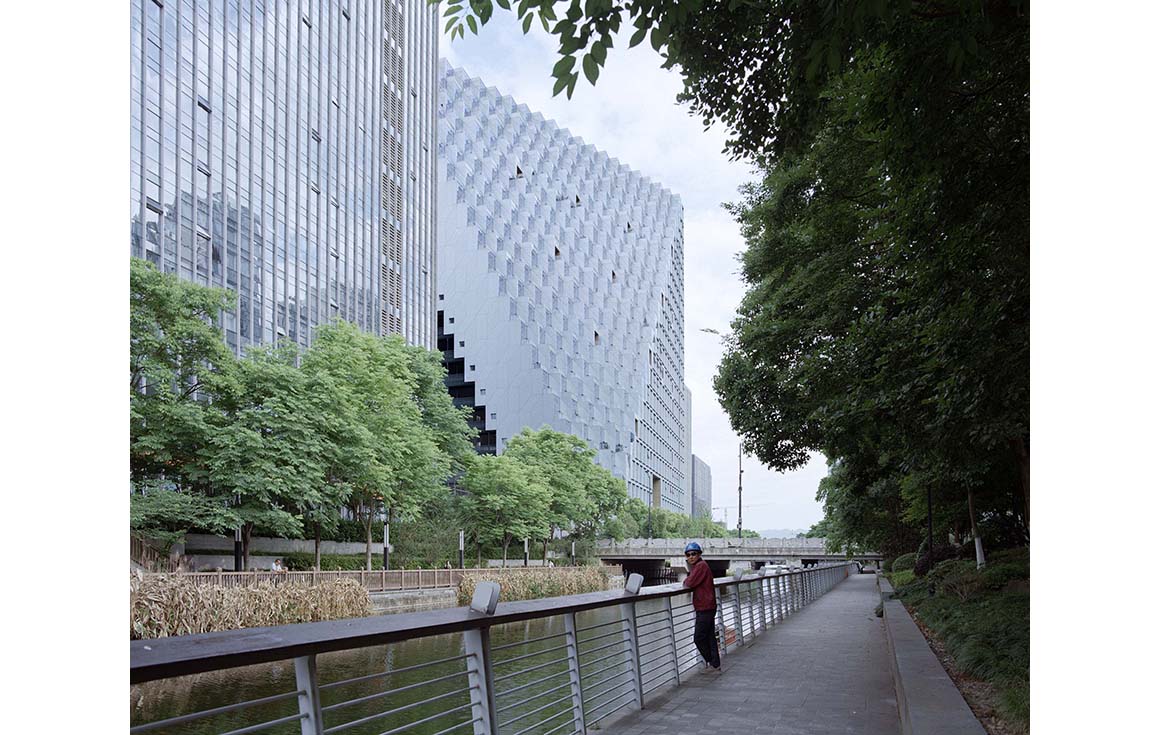
Something else also gradually happened during construction. The site has two commercial streets: one along the Moon Tower and another along the Prism. The Prism receives those flows and gives people a natural point to turn around, creating a loop between the commercial streets, the shopping malls, the canal, and the surrounding residential areas.
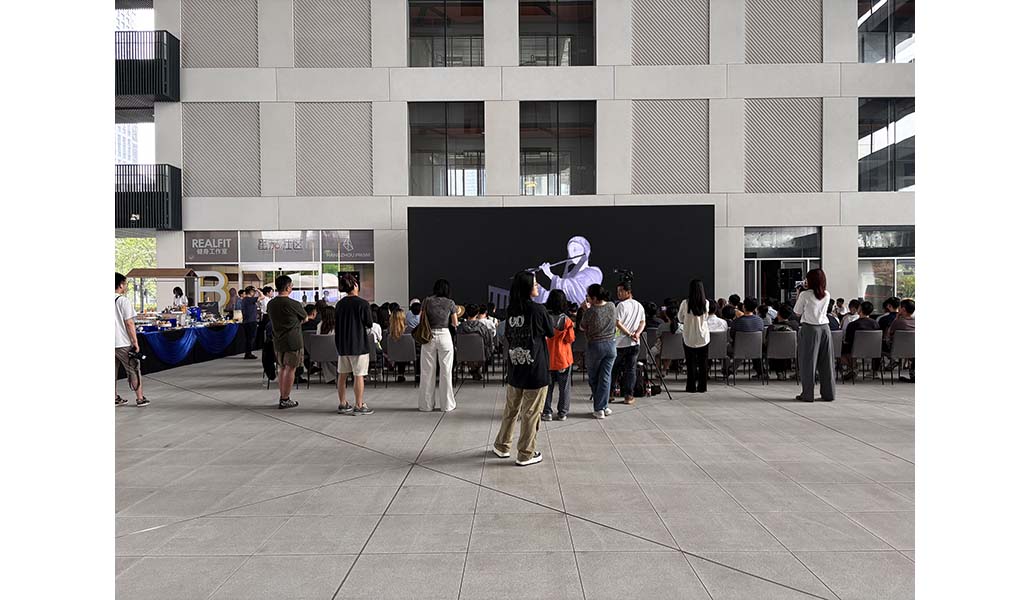
Even during construction, people began to recognize the potential of the space. They asked the client whether they could organize a fashion show there, or a dragon dance for Chinese New Year. The client became increasingly interested in the possibilities of the space — weekend markets, flea markets, and many kinds of events.
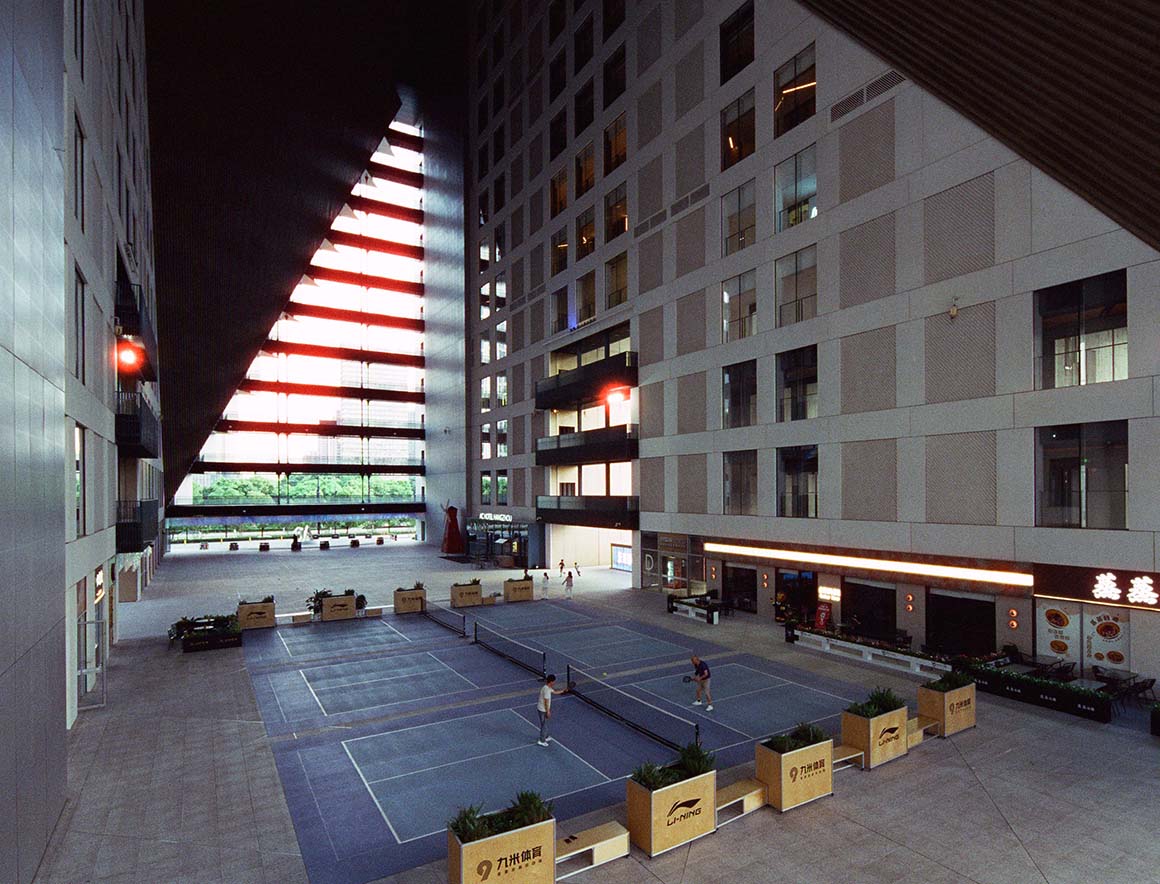
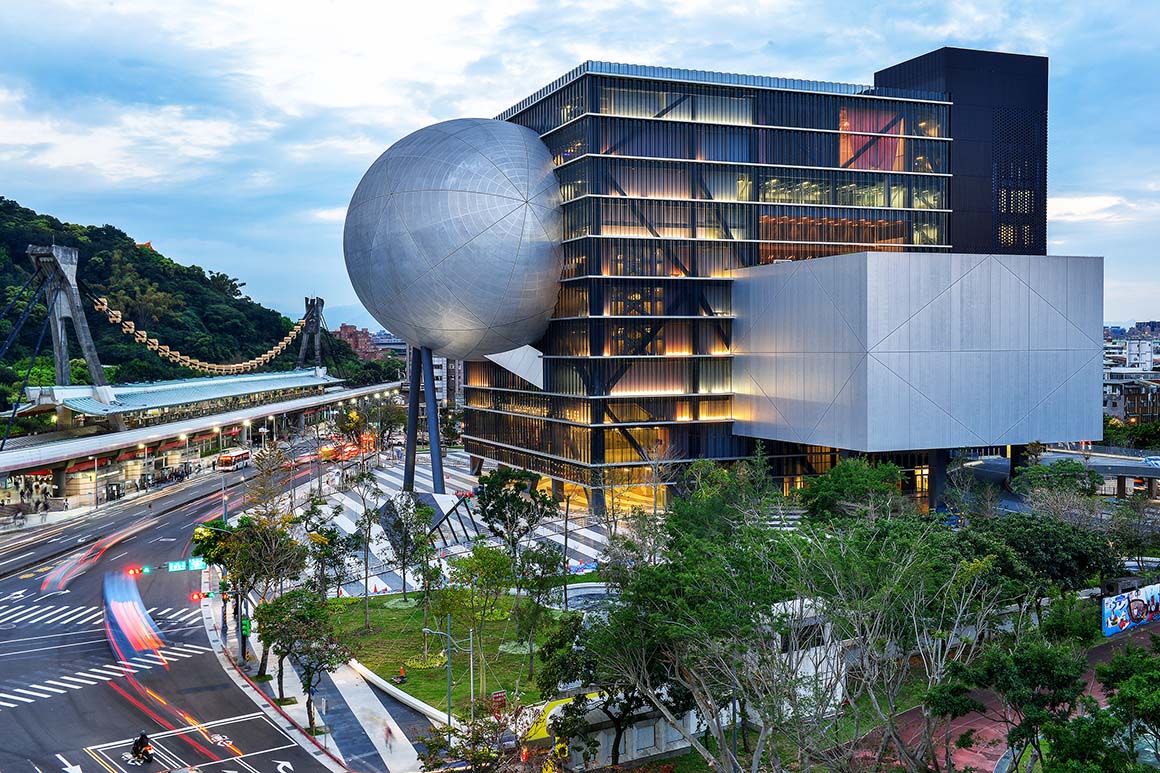
The space is outside, but it is protected. The building is porous and there is no fence, yet it is comfortable and safe enough to host activities. If it rains, or if it is too hot, the space can still be used. In terms of scale, you could compare it to a European cathedral. It is about eighty meters high in the middle, and you could easily fit a cathedral inside. But it does not feel intimidating. Even when not much is happening, it is pleasant to be there. The acoustics work well, and there is enough daylight during the day, so artificial light is not necessary.
At the opening, children were riding bicycles, people were playing tennis, there was a small cocktail bar at the back, and people were sitting on the elevated terrace, talking and making music. All of this was happening in one space at the same time. I think that is exactly how the space should work. Some things are programmed, while others are not. The space is large enough for all of them to happen simultaneously.
In China, there is not really a strong culture of urban squares in the traditional sense. Many new towns have open spaces and green parks, but they often function more like generous corridors. It is harder to find specific places where activity and energy are compressed and concentrated. You would not play tennis inside a shopping mall; they probably would not like it. But here, the client supports it. Nobody stops children from riding bicycles there. Because the space is protected, these things can happen.
So the built space is different from the early landscape imagination. But through that shift, it has gained another kind of possibility: a flexible, open, and welcoming public space.
Asking the Right Question Before Invention
YuMi Hyun: During the panel discussion on the opening day, Robert-Jan van Santen made an interesting comment. He said that OMA’s innovation does not come from pure invention, but from asking the right question before invention begins. Do you agree with this interpretation?
Chris van Duijn: Yes, I think so. In an ideal process, or in an ideal project, you define at the beginning what the project is really about.
With Hangzhou, for example, the situation was quite clear to us. We understood why we were doing this building: to create an environment that could genuinely contribute to the idea of Future Tech City. Maybe it generates the next start-up, maybe it does not — that is not really the main point. But it becomes an element that fits this place, and perhaps an element that was missing.
It is similar to research. You can do a lot of research; you can search online, collect material, and read whatever you want. But if you have not asked the right question, it is probably wasted energy. So yes, raising the right question helps you develop the project.
In most projects, we do this quite deliberately. The beginning of a project is always the most exciting phase — the first two or three weeks, when you have an empty site, a client who wants something, and, in a way, a blank page. Everything is still possible. Of course, we check the brief, the requirements, and the basic conditions of the site. But then we push them aside for a moment. First, we brainstorm, develop ideas, and try to understand what the project is really about. What have we found? Sometimes it begins with writing, simply to organize your thoughts.
In the case of Hongik University, it was really about being there long enough. The challenge was: what is the spatial manifestation of the university? I do not know if you have read the competition brief, but it basically said, “We want a landmark.” Of course, that is almost mandatory in such briefs. But then it also said, “We want a building that is the spatial manifestation of Hongik University’s identity.” What is Hongik about?
That sounds very interesting, but it could mean anything. What is the spatial manifestation of a university, or of a university’s identity? You can search for universities and do all kinds of research, but in this case it was really about something physical.
So we went there with four people from the team. One of them had studied there, so he knew the campus. We stayed for four or five nights. During the day, we literally behaved like tourists: walking around, checking all the buildings, going down, getting lost many times, eating there, talking to students and professors. We also spoke to people who had worked and lived there for forty years.
Gradually, we tried to grasp what makes this university campus different, what gives it a different atmosphere from other places — from, say, Yonsei University, which is of course completely different, almost the opposite.
So yes, asking the question and defining what the project is about are very important. Of course, in some projects this is easier than in others. In some projects, you find something more relevant or meaningful; in others, it is more difficult. But in both Hangzhou and Hongik, we found something that felt worthwhile to explore.
If you have a commercial mall, for instance, it is less easy to define that, because the client may already have a very precise definition of what the project should be, according to them. But even then, we try to bring in our own narrative, or multiple narratives.
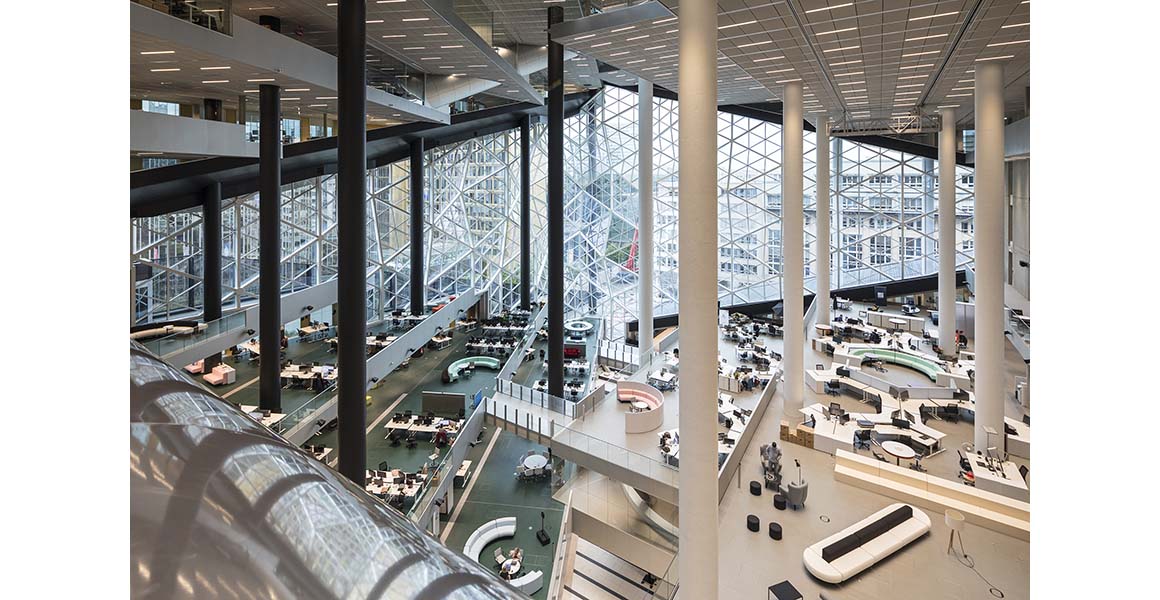
That is what I tried to explain with the Berlin project. Last year, I gave a lecture where I presented that building five times in one hour. Each time, I started with the same photograph of the atrium and said, “Now I am going to explain the atrium.” And each time it became a completely different story. But all five stories were true.
I think that when projects relate to their immediate surroundings, or to a more symbolic meaning — for example, Berlin’s history — they become more relevant, more interesting, and more specific to their sites. Sometimes it is about absorbing something from the context. Sometimes it is also about feeding something back into it.
Observation as a Conceptual Tool
Pedro Ferreira: You have opened many topics. I would like to focus on observation, which also overlaps with what you just said. How important is observation in OMA’s design method, or in your own design approach? At what point does looking at a place become a conceptual tool? And, in the case of Hongik University, how did your observations transform the original competition brief into the strategy that eventually became the winning proposal?
Chris van Duijn: Competitions have two sides, as you know. On the one hand, you have the same brief as everyone else, and usually the client wants to keep the process fair. It is then up to you to decide how literally you follow the guidelines, or whether you break away from them and take a risk.
A competition always involves risk. If there are ten teams, you have a ten percent chance of winning. So the question is: do you develop the project based on what you think the client wants to see, in order to maximize that ten percent? Or do you say, even if we do not win, at least we will have had fun and made a good project? That is an attitude.
In a competition, you usually do not have direct engagement with the client, so you cannot really test things with them. With Hangzhou, for instance, we developed many models in the very first workshop that the client had never asked for. But that was part of creating a dialogue.
One thing I have learned is: never ask clients open questions. They usually do not know how to answer them. And if they do answer, it is often based on their own limited experience, or because they want to be polite. So I try to avoid open questions and instead create a dialogue through which we can understand them better.
In a competition, however, that is almost impossible, so you have to go in the other direction. You can be more selfish, and in a way more entrepreneurial.
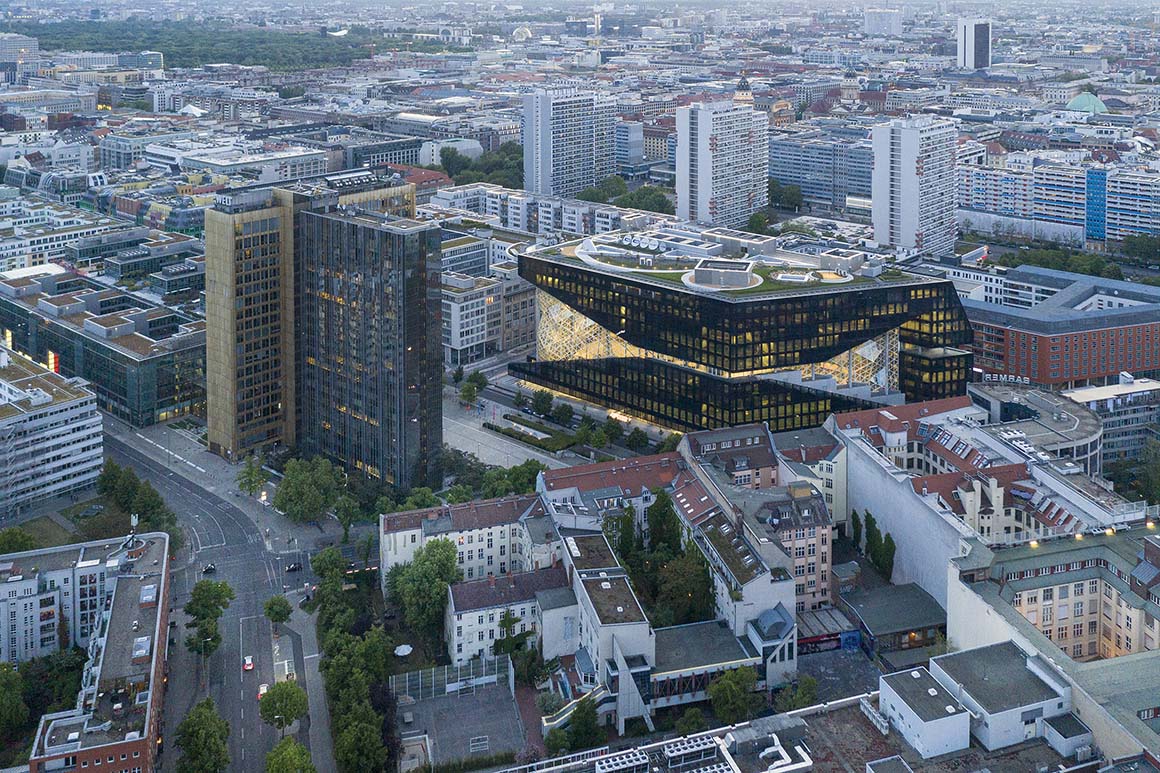
I think that is what we tried to do with the Axel Springer project. OMA is often associated with Rem Koolhaas’s phrase “fuck context,” but it is usually misunderstood and taken out of context. It was not simply a declaration that context should be ignored. Rather, it described the complex relationship that architecture, beyond a certain scale, establishes with the existing urban fabric. In that sense, context is not something to be followed literally or represented superficially. It is what allows you to raise the right questions.
But context can mean many things. It is partly the street around you, the neighbors, the shadows, the existing trees, and other physical conditions. In the case of Axel Springer, however, context also meant understanding what the company was going through. Why was this competition organized? Because the company was transforming from an old-fashioned media company into a new digital media company. It was also acknowledging the emergence of pop-up culture. If that change was going to happen, perhaps it was better to take charge of it than to let it happen passively.
At the same time, we had the opportunity to look at Berlin as a city, with its very particular history. So analyzing context was something we spent a lot of energy on at the beginning. You start, you see what you find, and then you try to identify what is most relevant by asking the right questions.
Beyond Generic Internationalism and Superficial Local Symbolism
Pedro Ferreira: From my understanding, OMA often avoids both generic international architecture and superficial local symbolism. The projects do not simply attach symbolic elements taken from the local context. In the case of the Seoul campus project, were there any context-specific aspects behind the scenes that became operative or organizational in the design? In other words, what aspects of Seoul, Hongdae, or Hongik University became architectural rather than merely symbolic?
Chris van Duijn: The fact that we do landmark projects is, of course, something we encounter often. Many of our projects start with competitions, and many competition briefs begin with a phrase like, “We want a landmark.” But we also like to question that. What do you really mean by a landmark? Do you want something that is just visually extravagant? And if so, why?
So we have a kind of love-hate relationship, or at least a very ambiguous relationship, with the idea of the landmark. Clearly, it is not about applying a local style. You could argue about that, but there are projects where we really try to avoid that, because it does not make the project better.
I have said this before, including to Chinese journalists: often, landmarks become a kind of compensatory bandage for planning. They become a visual distraction from the mediocrity of what has been designed in an area. But there is no reason why a building should be relevant only because it has been designed as a landmark. The question is whether we can contribute in a more meaningful way than simply creating something that looks different.
One example is the bridge we designed for Bordeaux. The question there was: this is the budget; should we spend it on a complicated structure that may look striking? Or should we make a bridge not only to cross, but also to stay? That was the more meaningful question.
Regarding generic architecture or superficial symbolism, sometimes using neutral architecture, or very typical architectural elements, can actually be part of the plan.
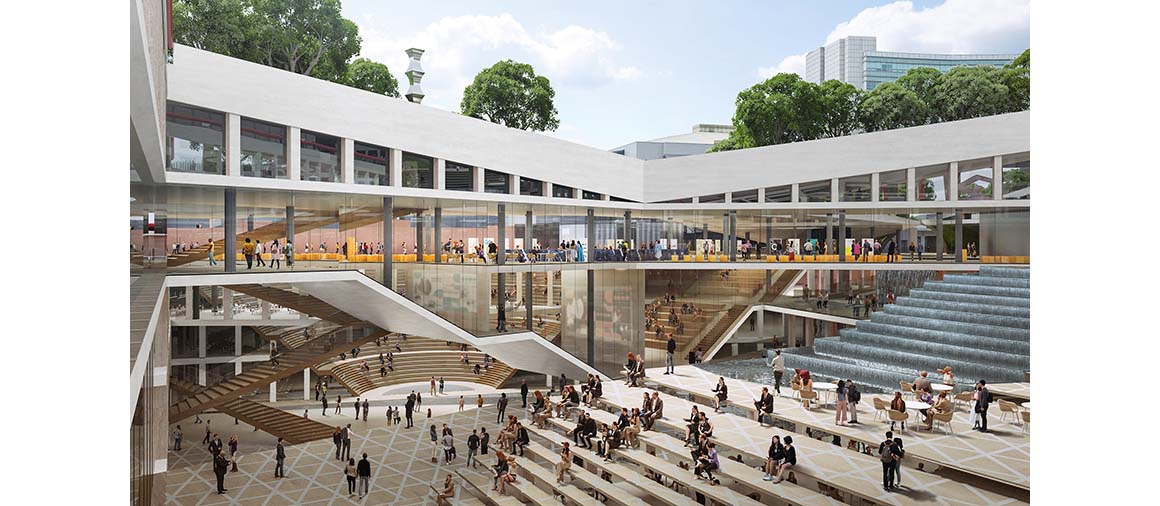
With Hongik University, when we walked through the campus, we realized that all the existing buildings form part of what they call the identity of Hongik — the identity they wanted to express. But the most important thing was that the campus functions as one organism. It is not simply about buildings and the spaces between buildings. It is not about each building being a faculty with its own identity.
When you move through those buildings at different levels, you become completely lost. You do not know what the ground-floor level is. You do not know which building you are in. Sometimes you do not even know whether an outdoor space is accessible or whether you are supposed to be there.
Art students take over one courtyard. In another courtyard, engineering or technology students build a racing car. Nature invades these spaces. The buildings themselves look very different. In fact, it is not about buildings. It is not about architecture in the conventional sense. What has been created is an infrastructure, or an organism, that apparently feeds the students. They occupy it. They use the campus in a very opportunistic way.
Students here do not stay within their faculty building. They do not stay within the walls. It is a little bit like our office, where we have a model shop with balconies around it and access to the roof. Everything gets spray-painted, because people go outside and spray-paint everywhere. Everything gets taken over. That is also what is happening here.
And then, one step beyond Hongik, there is Hongdae. You find the same energy in Hongdae: events, street artists, people occupying porticos and taking over places. That is the spirit.
So we do not need to design a building with beautiful façades and architectural complexity. Not at all. We should create an environment that is fluid, with no clear boundaries between inside and outside, or between different programs in the building. It is really infrastructure.
In that sense, the façade can be functional. It becomes a background for the project. It is not about itself.
If I have to explain the Hongik project, I would explain it in terms of topography, landscape, public space, interior movement, and connectivity. Only much later would I talk about the façade — and perhaps that is what people would call the architecture. But more than eighty percent of the project is hidden.
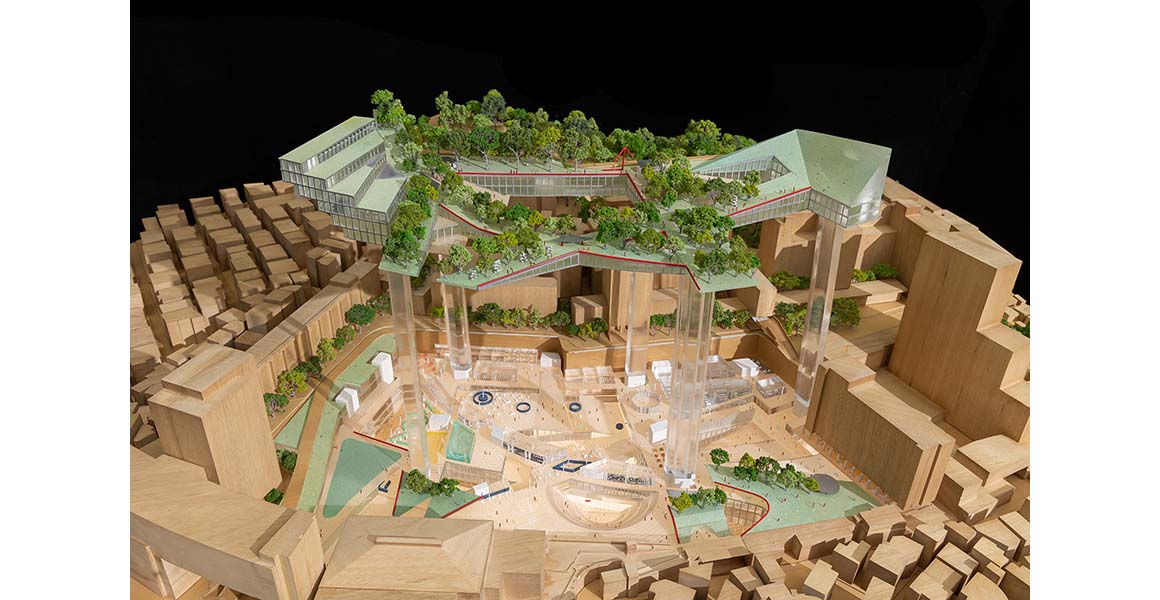
I think the biggest success of the project is that we left the center of the space open. In the future, you will still be able to sit on the roof, look down over the city, see the National Assembly in the distance, and just sit there, relax, smoke, or do whatever you want to do.
And to come back to your question, it is not an interpretation by a foreign office saying, “Let’s create something Korean,” or looking at the detail of a window or roof tiles. When people invite an international office like ours, they want something that does not already exist. But it has to work here. It also has to blend in. Otherwise, it does not function.
The Campus as Infrastructure
Pedro Ferreira: This is exactly the point I was thinking about: the project becomes a landmark without having the conventional presence of a landmark building. It is less about an iconic object and more about an urban condition. This also connects to the idea of the campus as infrastructure. The “invisible landmark” seems to come from the need to connect several different layers. As you were saying, architecture in Seoul has to negotiate topography, density, and compressed public space all at once. How did you bring this demand for connectivity into a real structure? What were the steps behind turning all these urban conditions — formal and informal — into an architectural system?
Chris van Duijn: The history of the site is important. The Hongik University campus was built mostly in the late 1960s and early 1970s, I believe, more or less in parallel with the development of the Hongdae district. The current plot, which is mainly sports fields, used to be a natural connection to the Hongdae neighborhood. People parked their cars there. The campus was, in a way, U-shaped, and this sports field or open space connected it to Hongdae.
Over time, more and more buildings were added. For instance, the entrance building, or gate building, was built. A gate, of course, brings people in, but it is also a form of defence. It separates and controls. Then the art and design campus building was also built along that line. Gradually, this open space became disconnected.
So our aim was to undo that separation.
When we walked around the campus, we also noticed that there is a twenty-meter height difference between one end of the site and the other. It is very complicated to move around. As I explained earlier, the buildings are connected, but in confusing ways. You enter here, take the elevator to the fifth floor, then walk to the next building or to the library, then go up again or down again. It is like Hogwarts — very complex.
But if you walk around for a while, you can identify certain main nodes. From those points, you can easily move into a building or to the next layer. We identified these nodes as important for students and for everyone working and living on campus, because they help people find their way into the surrounding existing campus.
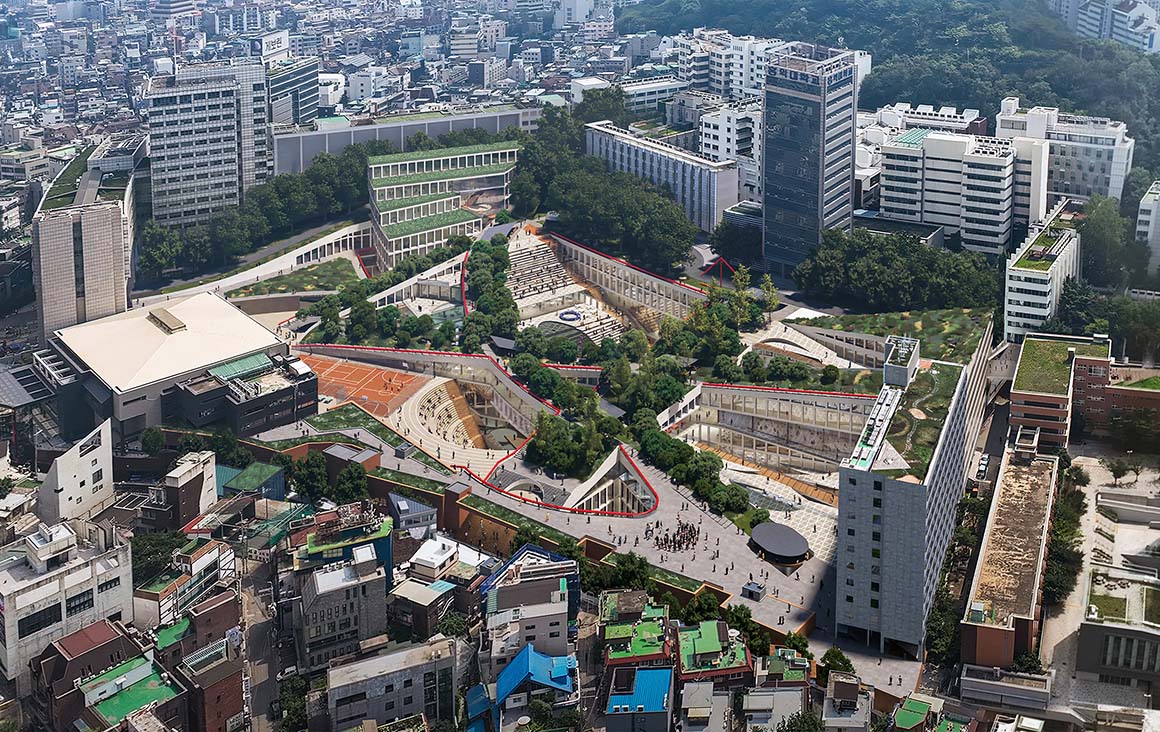
On the city side, we also identified three nodes. Ideally, if we could make openings there, we could connect the neighborhood with shortcuts. Once we decided to sink the building, we said: let’s basically reinstate the original slope of the mountain. Wau Mountain is the name of the mountain behind the campus. If we continue that slope, then there is a natural connection upward. We reconnect the site through those nodes, and from there people can take shortcuts in different directions.
That was one part of the plan.
The second part relates to something very relevant: the changing demographics of Korea. One thing is clear — universities will soon have many fewer students than they do today. So while we are developing this campus building for educational purposes, we also have to ask: in two decades, will there still be 18,000 students at Hongik University? Or how many will there be?
So the campus building is for education, but it also has to be able to transform over time into an area for companies, makers, and others. It should bring academia and the rest of the world together, physically but also functionally and programmatically. This was also raised after the competition by the university and by the chairman. They all see this coming.
What we proposed, then, is based on the section. The section is probably quite complicated, but the nice thing is that we have two datum floors. The lower datum floor is the Hongdae level. We use that whole floor as a level for everyone, with mixed programs: cafés, the museum entrance, auditoria that can also be used for other events, the library, and so on. All these programs create a kind of connection, a continuation of the public realm, or at least of the neighborhood.
The educational program is above and below this level. In that way, we also create future flexibility. So, in plan, it is about the nodes. In section, it is about the programmatic organization and this Hongdae level. These were the three main things that shaped the project: the slope, the connections, and the injection of flexibility through the central level. That was basically the main idea.
All of this was based on analyzing the site, its history, and also trying to project its future. One thing I often say is that cities and buildings are never finished. This idea of plannability, which we see in China, often projects a permanent condition onto the moment of completion. But cities and buildings are constantly adapting and changing. It is very naive to think that, because something is designed for one purpose, it will always remain that way.
So our architecture is infrastructure.
We said: let’s design a typical width of eighty meters, with a structural grid that is efficient to build. It is all cast-in-place concrete, because that is how they build here. The infill is flexible. It can be classrooms, offices, laboratories; it can become more library space or something else. Of course, at the junctions and under the sloping roof, where there is more floor-to-floor height, there are opportunities for special moments. But the basis is really infrastructure.
We tried to keep that infrastructure as intact as possible, because that is what allows the university to constantly adapt and change its program and its way of using the building in the future.
Seoul’s Changing Urban Energy
Pedro Ferreira: That seems very much about creating opportunities. The project creates unexpected encounters, and those encounters will be as unexpected as the city around it changes. In that sense, it is almost life-proof.
Chris van Duijn: Exactly. And then we are back to the story of Hangzhou as well. This level is where you hope that the creativity already present at Hongik University can combine with the creativity of Hongdae. There are so many people there. That combination is the potential.
Seoul has developed so much over the last twenty years. It has really become a very different place — from what was once a more introverted society to something much more international, expanding, outgoing, and self-conscious. I think that is also something we want to broadcast through the project.