

Wednesday, December 31, 2025
  • About C3
  • Advertising
C3GLOBE
  • Latest

    Architecture of Possibility: Zaha Hadid Architects

    No. 8 House in Dongnan Village

    SAIER

    My Montessori Garden

    Forest Edge

    Herriko Plaza

    Mogokri House

    Drevak

    The Taichung Green Museumbrary

  • Architecture
    • All
    • Asia
    • China
    • Japan
    • Korea
    • World

    No. 8 House in Dongnan Village

    SAIER

    My Montessori Garden

    Forest Edge

    Mogokri House

    Herriko Plaza

    Drevak

    The Taichung Green Museumbrary

    HO-UN

  • Competitions
    • All
    • Call for Entries
    • Results

    Mextrópoli 2026 Pavilion

    BIG unveils ‘The Sail’, a mass-timber community and convention center in Rouen

    Snøhetta Wins Design Competition for the Hangzhou Qiantang Bay Art Museum

    MVRDV’s “Grand Ballroom” wins competition for mixed-use arena, housing, and hotel complex in Albania

    JKMM Architects wins international competition for Architecture and Design Museum of Finland

    EUmies Awards Young Talent 2025

    BIG Wins International Competition for Hungarian Natural History Museum in Debrecen

    Six finalists for Nelson-Atkins Museum of Art Expansion

    Montjuïc Exhibition Center Remodeling – Barcelona Expo 100th Anniversary Competition Result

  • News

    Architecture of Possibility: Zaha Hadid Architects

    Seung H-Sang Exhibition in Vienna, ‘Architecture and Words’

    Frank Gehry Studio

    Frank Gehry, Icon of modern architecture, dies at 96

    Wang Shu and Lu Wenyu of Amateur Architecture Studio named the curators of the 2027 Venice Architecture Biennale

    2025 Holcim Awards Winners Announced

    UNESCO Launches Virtual Museum of Stolen Cultural Objects Designed by Francis Kéré

    The 7th Baku International Architecture Award Results

    The 5th Seoul Biennale of Architecture and Urbanism Opens

    The 7th Lisbon Architecture Triennale

  • :
  • C3Magazine
No Result
View All Result
  • Latest

    Architecture of Possibility: Zaha Hadid Architects

    No. 8 House in Dongnan Village

    SAIER

    My Montessori Garden

    Forest Edge

    Herriko Plaza

    Mogokri House

    Drevak

    The Taichung Green Museumbrary

  • Architecture
    • All
    • Asia
    • China
    • Japan
    • Korea
    • World

    No. 8 House in Dongnan Village

    SAIER

    My Montessori Garden

    Forest Edge

    Mogokri House

    Herriko Plaza

    Drevak

    The Taichung Green Museumbrary

    HO-UN

  • Competitions
    • All
    • Call for Entries
    • Results

    Mextrópoli 2026 Pavilion

    BIG unveils ‘The Sail’, a mass-timber community and convention center in Rouen

    Snøhetta Wins Design Competition for the Hangzhou Qiantang Bay Art Museum

    MVRDV’s “Grand Ballroom” wins competition for mixed-use arena, housing, and hotel complex in Albania

    JKMM Architects wins international competition for Architecture and Design Museum of Finland

    EUmies Awards Young Talent 2025

    BIG Wins International Competition for Hungarian Natural History Museum in Debrecen

    Six finalists for Nelson-Atkins Museum of Art Expansion

    Montjuïc Exhibition Center Remodeling – Barcelona Expo 100th Anniversary Competition Result

  • News

    Architecture of Possibility: Zaha Hadid Architects

    Seung H-Sang Exhibition in Vienna, ‘Architecture and Words’

    Frank Gehry Studio

    Frank Gehry, Icon of modern architecture, dies at 96

    Wang Shu and Lu Wenyu of Amateur Architecture Studio named the curators of the 2027 Venice Architecture Biennale

    2025 Holcim Awards Winners Announced

    UNESCO Launches Virtual Museum of Stolen Cultural Objects Designed by Francis Kéré

    The 7th Baku International Architecture Award Results

    The 5th Seoul Biennale of Architecture and Urbanism Opens

    The 7th Lisbon Architecture Triennale

  • :
  • C3Magazine
No Result
View All Result
C3GLOBE
No Result
View All Result
Home Architecture Korea

Pavilion of Floating Lights

Draw upon Korean tradition
JK-AR

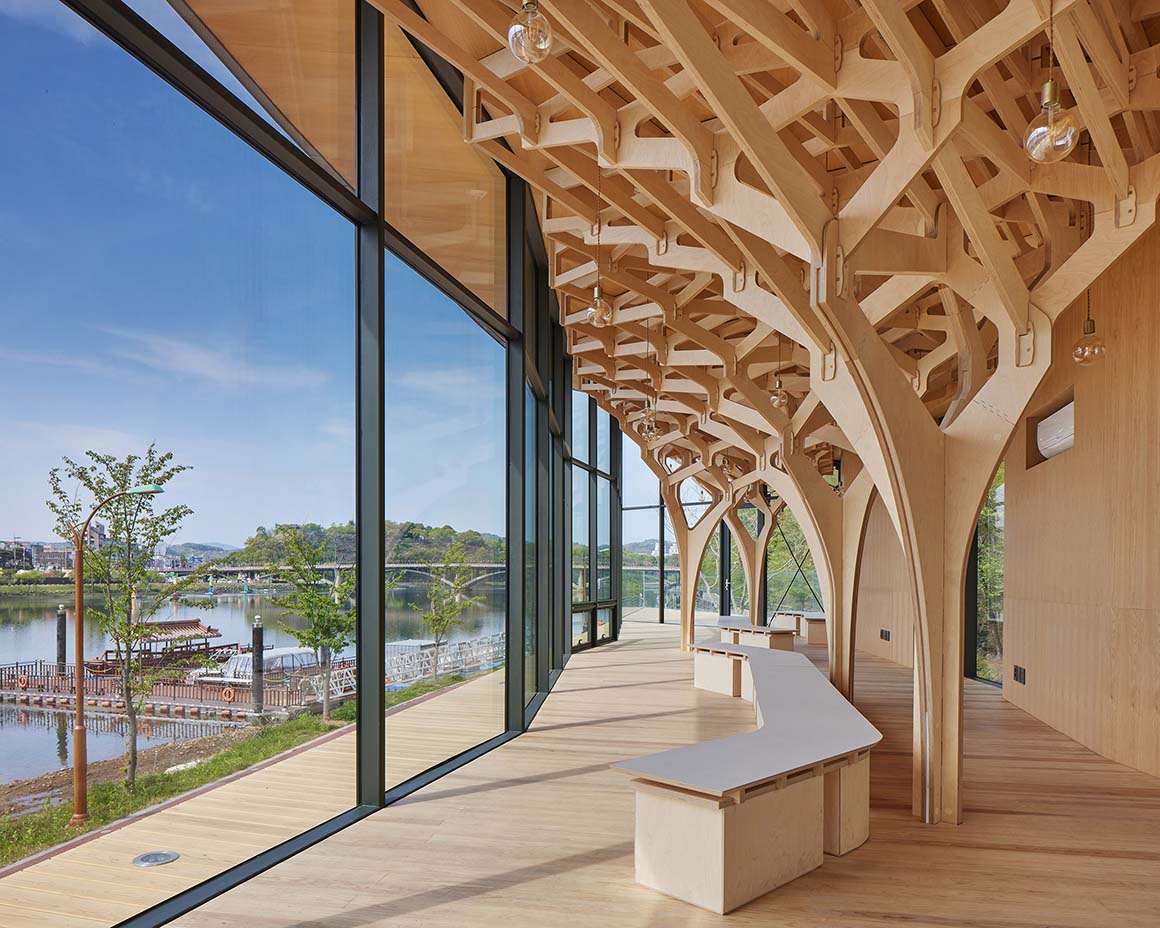
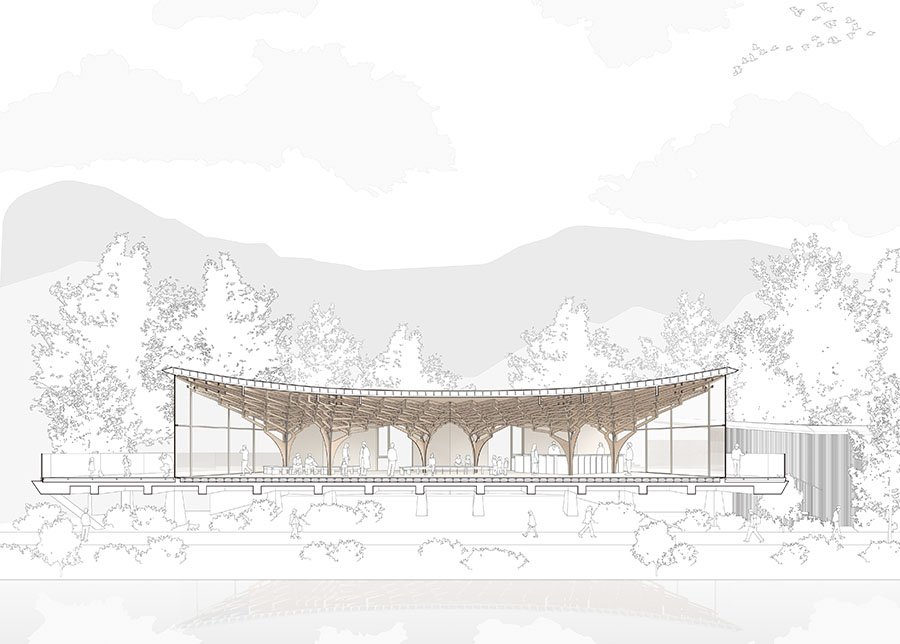
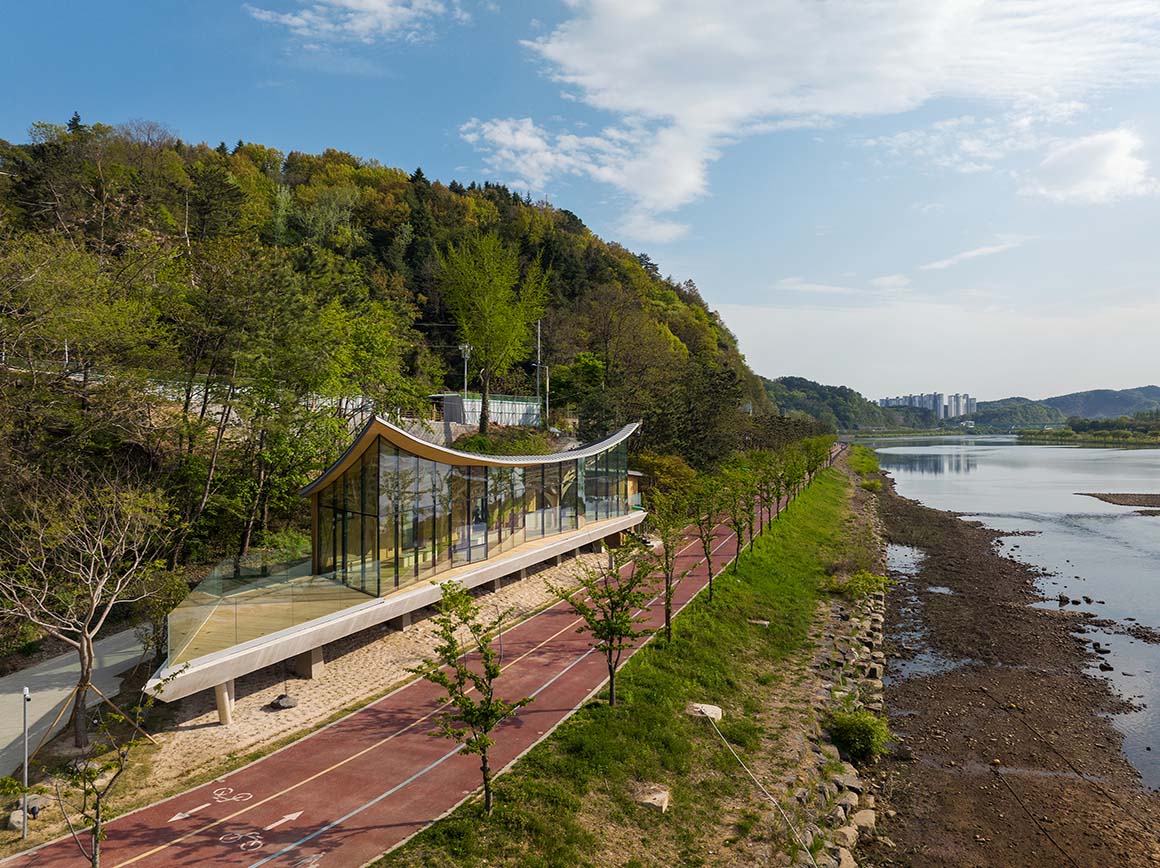
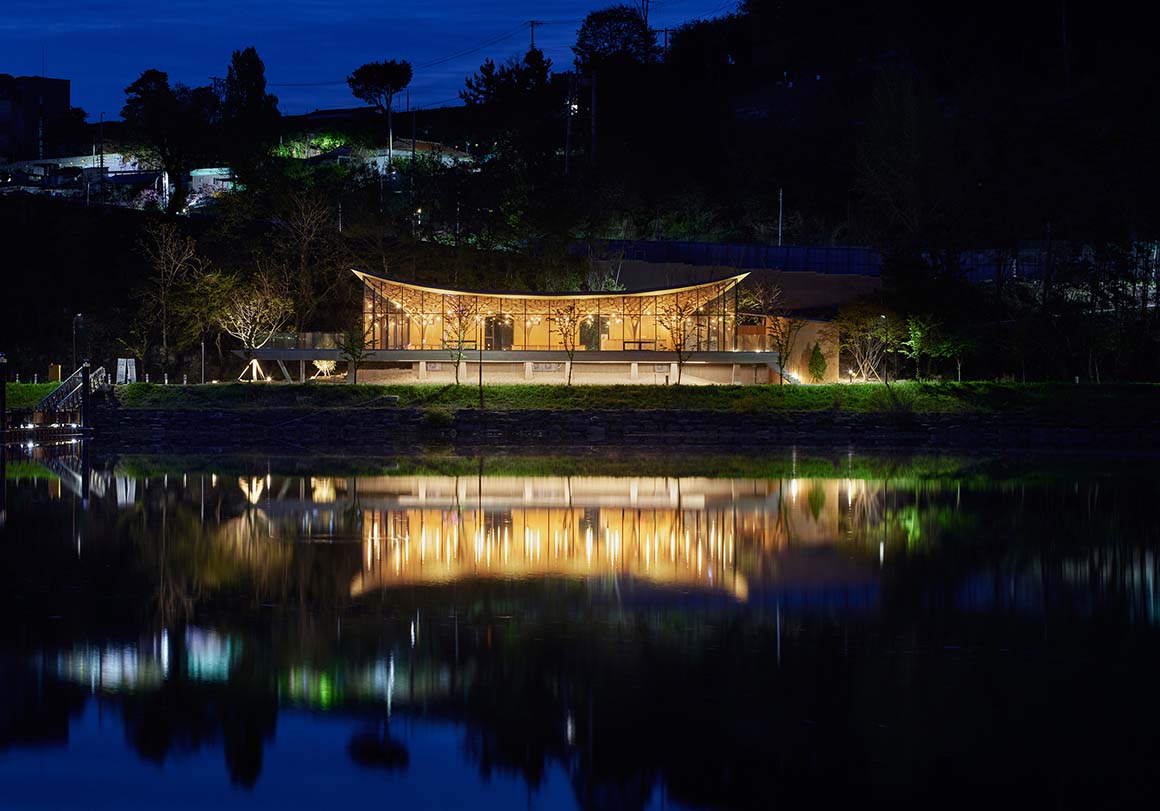
‘The Pavilion of Floating Lights’ aims to reinvent East Asian timber architecture, especially ‘-ru’, the East Asian equivalence of a pavilion in bigger scale. Traditional assembling technics and structural systems such as wooden brackets are used in six tree-like columns. The structure pays homage to six pillars of the front side of Chokseok-ru built in 1365, the most symbolic building in the city of Jinju of Gyeongsangnam-do, Korea
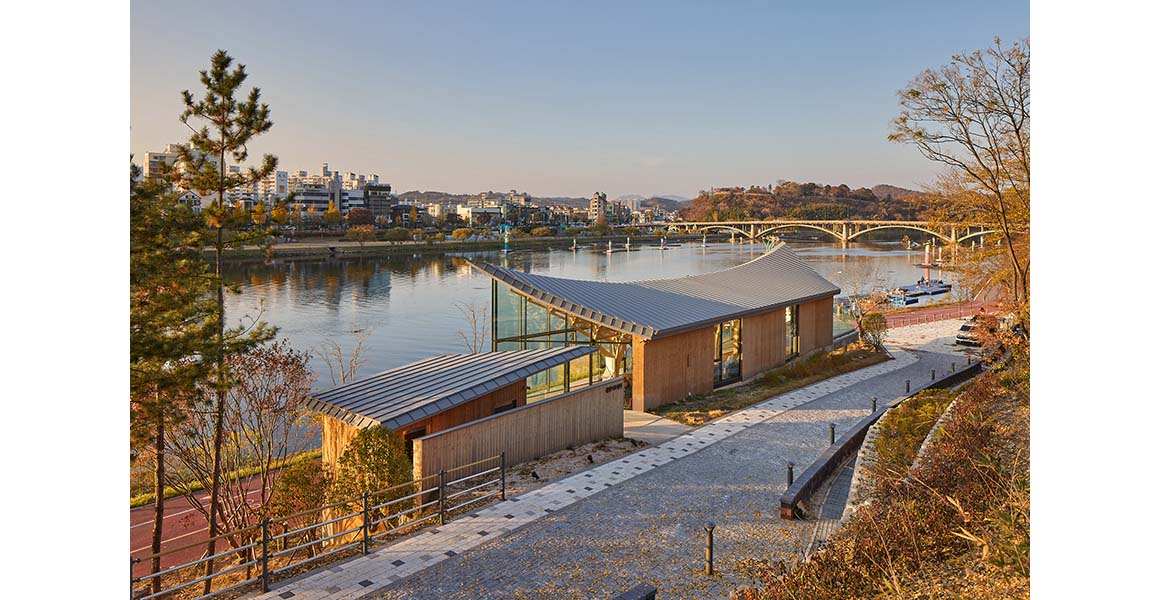
Centered on the Namgang River, the 14th-century Chokseokru and the National Jinju Museum are located to the north, the Gyeongnam Arts and Culture Center to the east, and the site area of the former Jinju station for Historical and Cultural Regeneration Project to the south. As the site sits on this significant axis, it reflects a strong awareness of the local cultural identity related to traditional architecture. Notably, it takes a creative and innovative approach to tradition, viewing it not merely as a continuation but as a starting point for new ideas. As a result, the space has been called a ‘21st-century Chokseokru’ and has attracted significant attention both domestically and internationally for presenting an alternative creative and technical approach to tradition. 
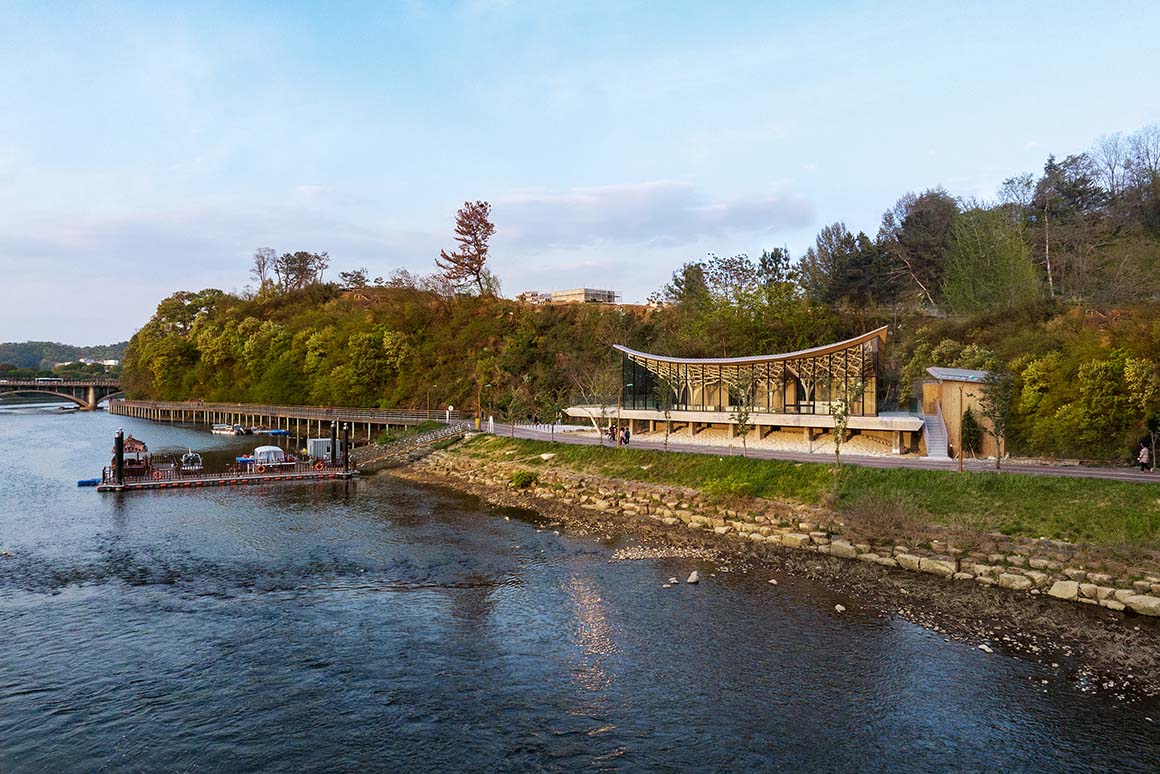
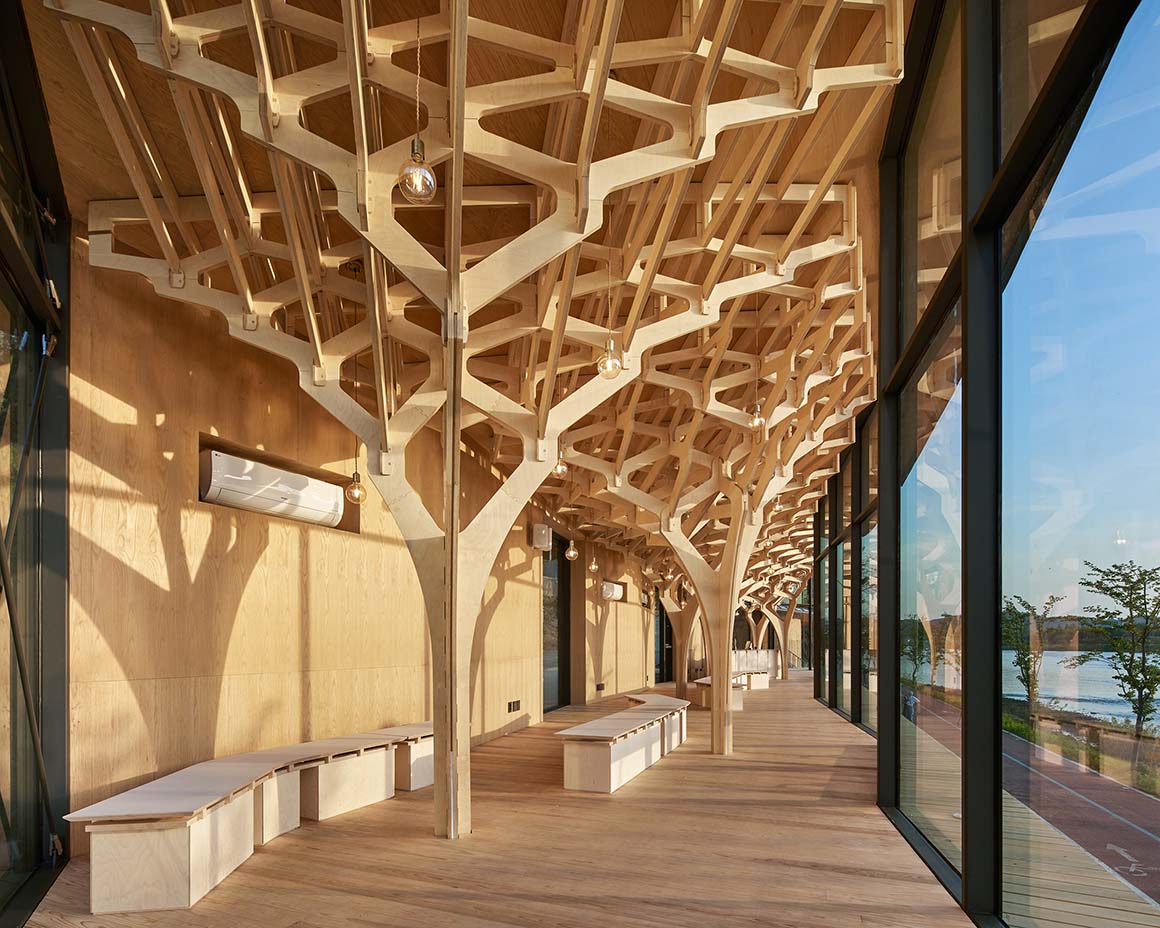
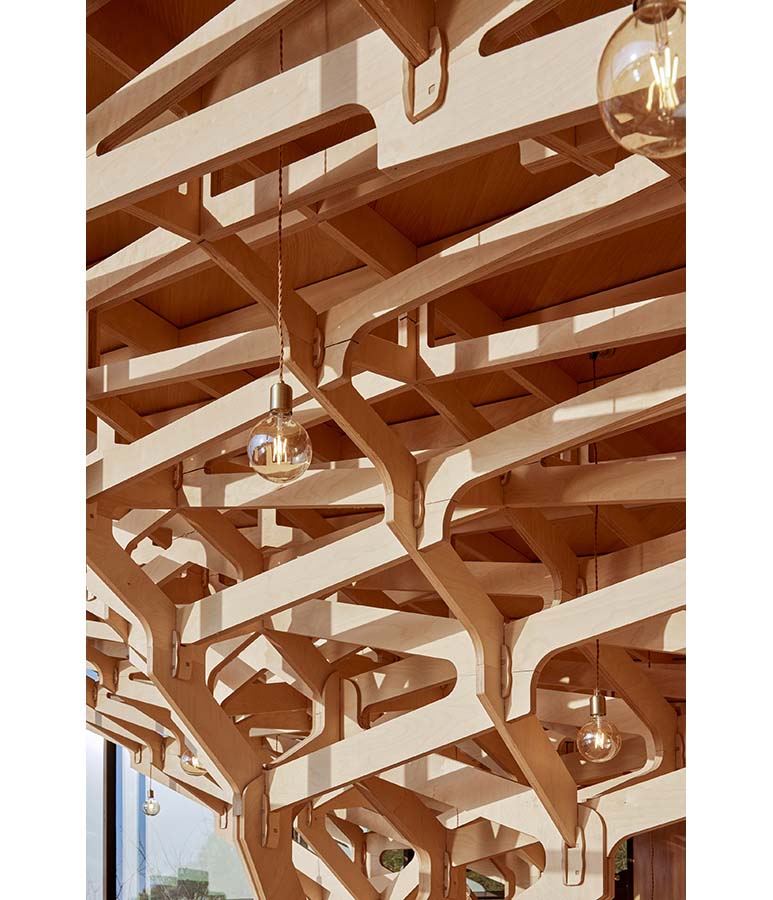
The most striking first impression is the six trees standing in homage to the six columns in front of the Chokseokru Pavilion. Through design computation, the furniture-like structural elements of traditional architecture, such as the scarecrow that connects the columns to the roof, are reimagined in a modern way. The use of nails and glue is minimized, and only the joining of wooden members is used to recreate the tradition in a modern way. To enhance the understanding of the structure and improve construction efficiency, a three-dimensional assembly manual was developed, incorporating augmented reality. This demonstrates the potential of blending traditional wooden structures with contemporary engineering and digital fabrication, creating a hybrid architecture of the past and present.
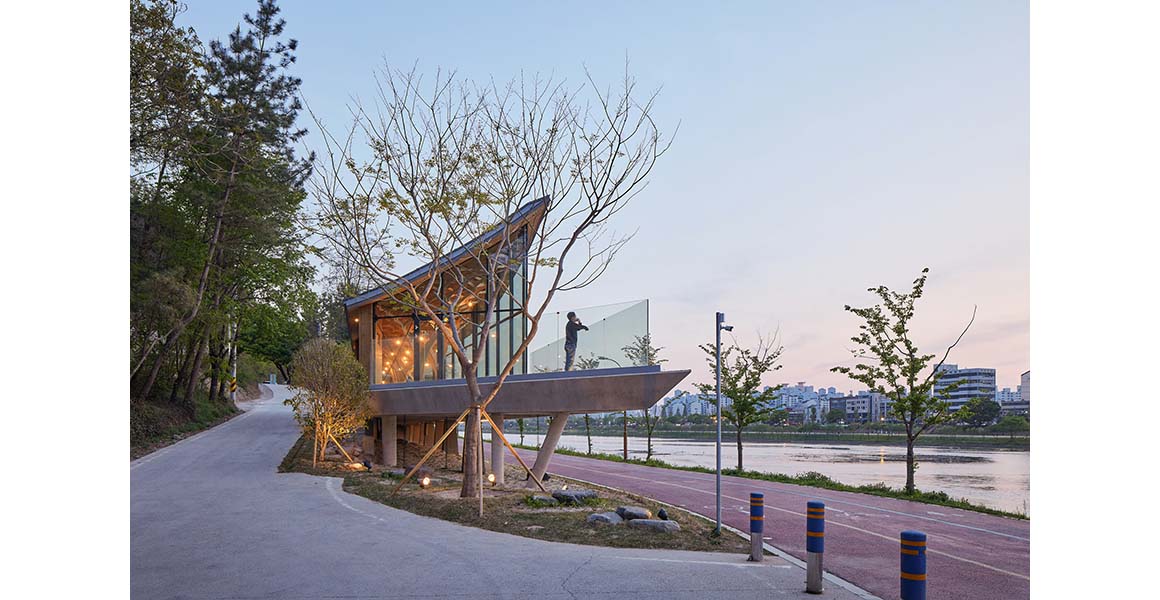
The term ‘Nugak(누각)’ refers to a pavilion-like structure elevated to offer views in all directions. In this pavilion, visitors can enjoy not only the natural beauty of the Namgang River and Mangjinsan Mountain but also the urban landscape, as three sides are entirely covered in glass walls, eliminating visual boundaries. It allows visitors to experience the ever-changing external natural environment throughout the seasons from the inside.
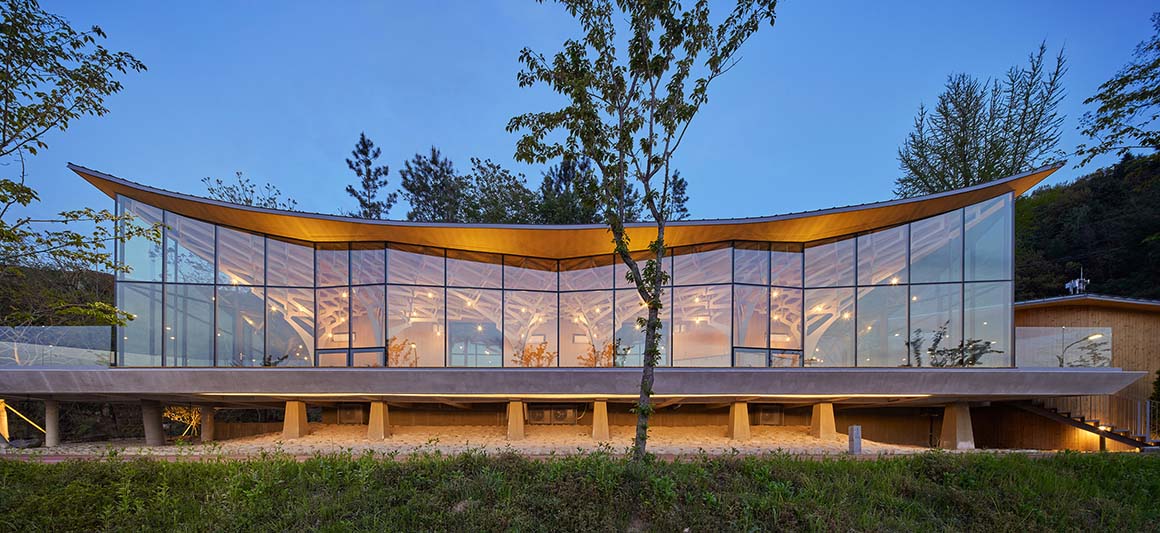
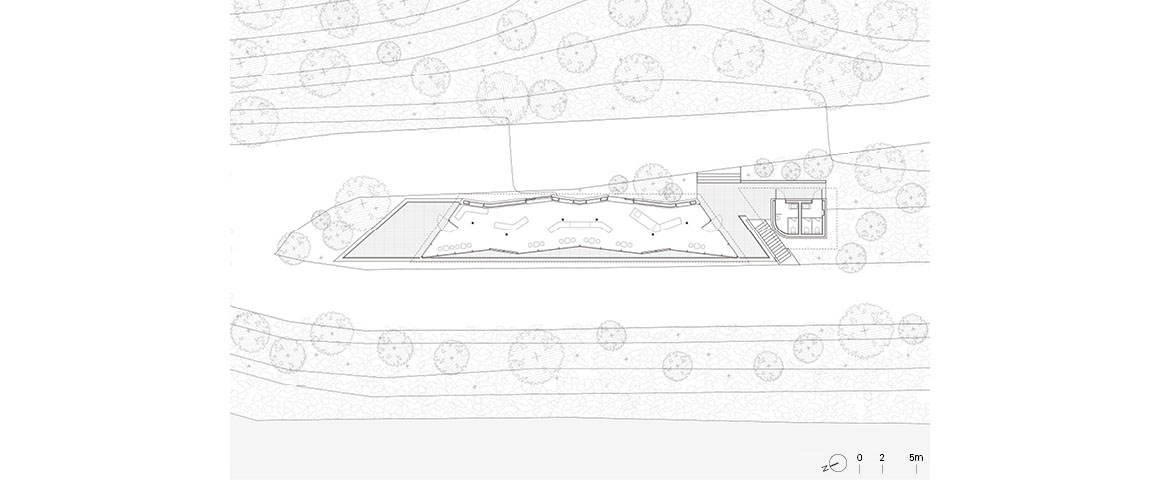
On the other hand, the interior is visible to the exterior, and the wooden structure is perceived as a facade. At the Lantern Festival, held in the Namgang River on an autumn night, the sense of openness and presence becomes even greater. The interior lighting shining through the glass walls turns the architecture itself into a giant lantern, illuminating the festival on the Namgang River.
The only enclosed wall, facing east, serves as a means of seismic resistance and captures the morning sunlight casting the shadow of trees. In the afternoon, it captures the shadows of the wooden structure as the setting sun casts them. Through the openings between the walls, visitors can experience the characteristics of three concepts simultaneously: natural trees, artificial trees, and the shadows of the wooden structure.
What if the Chokseokru Pavilion had continued to evolve over several centuries? The pavilion that originally served a particular social class may have evolved dramatically with advancements in technology and the convergence of public interest. ‘The Pavilion of Floating Lights’ is the result of imagining the possibilities. This is why it is called a ‘21st Century-style Chokseokru.’
Project: Pavilion of Floating Lights / Location: 195, Manggyeong-ro, Jinju-si, Gyeongsangnam-do, Republic of Korea / Architect: JK-AR / Project team: Jae K. Kim, Jisun Yoon, Na Young Jung, Gyu Tae Kim / Structural engineer: Hwan Structure / Use: observatory, cafe / Site area: 268,212m² / Bldg. Area: 109.98m² / Gross floor area: 119.19m² / Height: 6.21m / Structure: wood structure (birch plywood), RC (lower level) / Exterior finishing: SYP(southern yellow pine) wood siding, aluminum sheet roofing / Interior finishing: birch plywood, white oak plywood, T30 cedar deck / Design: 2020.12~2021.8 / Construction: 2021.8~2022.10 / Completion: 2022.10 / Photograph: Rohspace

Tags: JinjuKoreapavilion


Related Posts

Korea

Forest Edge

Between growing trees and standardized timber structures Joongwon Architects Layering identical materials to play a...

byc3editor
2025-12-26
Korea

Mogokri House

Aesthetics of boundaries overlaping connections and transitions eSou architects The outside light and shadow are...

byc3editor
2025-12-25
Korea

HO-UN

A house that rests like a cloud IROJE KHM Architects Along the lakeside of Jeonju’s...

byc3editor
2025-12-22
Korea

Donghwa Triangle School

An angular emphasis NAMELESS Architecture The site was once a piece of ground where greenery...

byc3editor
2025-12-15
Korea

Chronotope Wall House

Walls for concurrent spaces and continuous time Unsangdong Architects Time is trapped in space, yet...

byc3editor
2025-12-12
Korea

Toechon House

A house for inconvenient pleasures IROJE Architects & Planners This house was for a professor...

byc3editor
2025-12-05
Next Post

POP KUDAMM

  • About C3
  • Advertising
C3GLOBE

© All rights reserved. K-ARCHITECTURE | 18 GongHangDaeRo 2Gil GangSeo-gu Seoul 07622 Korea | Tel_+82 2 2661 1513 | Email_editorial@c3globe.com

Welcome Back!

Login to your account below

Forgotten Password?

Retrieve your password

Please enter your username or email address to reset your password.

Log In

Add New Playlist

No Result
View All Result
  • Latest
  • Architecture
    • Asia
    • China
    • Japan
    • Korea
    • World
  • Competitions
    • Call for Entries
    • Results
  • News
  • —
  • About C3
  • Advertising

© All rights reserved. K-ARCHITECTURE | 18 GongHangDaeRo 2Gil GangSeo-gu Seoul 07622 Korea | Tel_+82 2 2661 1513 | Email_editorial@c3globe.com