

A red ruin embraceing landscape


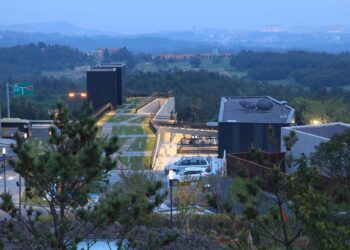
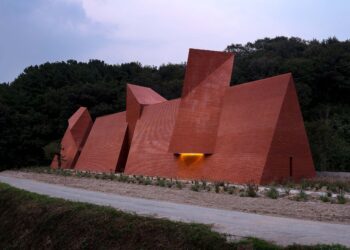
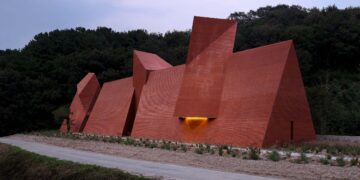
In Jeonryu-ri, Haseong-myeon, Gimpo-si, Gyeonggi-do, on a hill overlooking the Han River, a single red pyramid-shaped mass is positioned. Beginning with an architectural brief that aimed to create a “mecca of bakeries,” this project was realized to move beyond a simple café and allow the brand’s story to permeate and settle into the space.
The red-brick structure forms a contrast against the calm surrounding landscape, leaving a curious sense of unfamiliarity. The architect places the project’s origin at this point of contrast—an imagined genesis. The snow-buried landscape of Alaska, and the trace of an ancient civilization that might still sleep beneath the ice. This is an inquiry into the act of pulling an imagined civilization into built form, and lifting a non-existent world into architectural language. ABOGOGA is the result of translating that point of imagination into the architectural language.


The concept starts from a fictional setting: “ancient ruins preserved in perpetual snow.” Observing photographs of snowy landscapes, the architect imagined a structure forgotten beneath the snow, taking its expression and scale as the core of the spatial composition.
The key value of the architecture is openness that does not remain in a fixed form. The red pyramid is not defined as a singular, resolved graphic identity, but reveals formal variability that changes by viewing position, movement speed, and light angle. The form resembles the image of ruins that shift with climate and time. The internal circulation is composed with a natural rhythm similar to a walk, continually renewing scenes through movement and forming a flow of experience. The building operates as a structure that offers new perception and experience to visitors, beyond simply accommodating function. The exterior maintains a firm silhouette that evokes a pyramid, but upon entering, another world appears where rupture and connection are felt at once. Although the exterior reads as if split into three branches, the interior is interwoven and overlapped to form a single organic flow.


The circulation is clear yet dramatic. The entry is kept low and dim, intentionally hiding the river view. At a certain moment after entering, the landscape opens out, completing the first prepared contrast. The coffee desk hall at the center receives the river directly through a large window, while two masses of different depth and height interlock to create a rhythm of horizontal and vertical flow for staying. On the second floor of the first mass, multi-directional views are planned, allowing visitors to experience different layers of scenery depending on position.
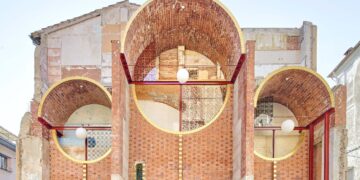
The materials are simple but carry depth. Red brick forms the spatial background, while terrazzo tiles, exposed concrete, stainless steel, and blackened steel plates are combined to evoke warmth and industrial tension at once. Light is restrained and precise. Slit windows hidden from the exterior and an upper glass opening pull daylight deep inside, subtly changing the brick surface by season and time. The interior maintains a stable weight centered on red and brown tones. Brown leather chairs and minimal lighting blend softly into the backdrop. The large opening toward the Han River creates a point of focus like a room prepared for landscape, allowing the interior atmosphere to harmonize with the scenery and draw naturally toward the view.


ABOGOGA stands as an architectural signature symbolizing the brand’s identity beyond the region. With the layered senses of an imagined civilization’s origin, a changing form, scene-building circulation, seasonal light, and material presence, the space is remembered like a small ruin or exhibition site. This project prompts reconsideration of the narrative and sensory range that commercial architecture can contain.
Project: ABOGOGA Bakery Cafe / Location: 977-19, Wolha-ro, Haseong-myeon, Gimpo-si, Gyeonggi-do, Republic of Korea / Architect: Sosokkianak (Gitae Jung) / Interior, and BI Design: Sosokkianak (Gitae Jung) / Architectural Construction Documents: Sosokkianak; WA20 Architects / Interior Construction Documents: Sosokkianak; InDesign Research Lab / Structural engineer: Renew Engineering Technology Office / Mechanical engineer: Deoksu ENG / Electrical engineer: Deoksu ENG / Landscape architect: Natural space / General contractor: InDesign Research Lab / Client: Jaegeun Ju / Use: cafe / Site area: 2,244m² / Bldg. area: 598m² / Gross floor area: 880m² / Bldg. coverage ratio: 26% / Gross floor ratio: 39% / Bldg. scale: two stories above ground / Height: 12m / Structure: RC / Exterior finishing: red brick / Interior finishing: ceiling_exposed concrete; wall_exposed concrete, stainless steel, blackened steel plate; floor_terrazzo tile, brick / Design: 2019.3~2020.3 / Construction: 2020.9~2021.12 / Completion: 2021.12.30 / Photograph: ©JungGyu Kim (courtesy of the architect)